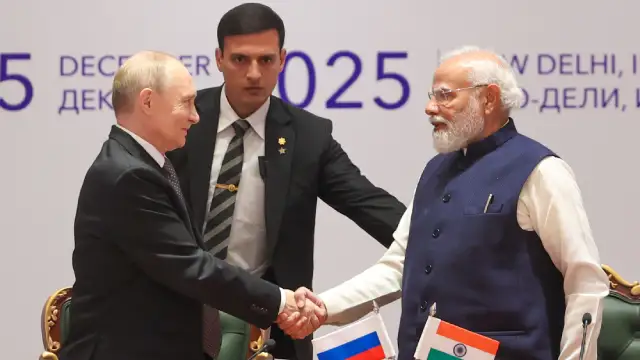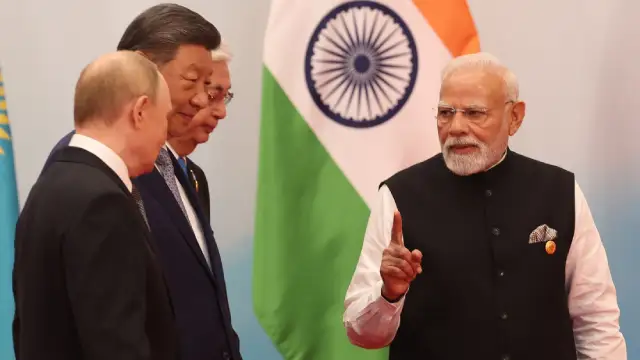
Indian Prime Minister Narendra Modi has embraced positions that directly contradict his government’s Western alignments. The prime minister signed the Tianjin Declaration on September 1st, 2025, during the Shanghai Cooperation Organization’s (SCO) summit in China.
Mr Modi’s endorsement of the Tianjin Declaration reveals profound shifts in India’s foreign policy calculations, although they seem temporary if the historic trajectory of New Delhi’s approach is analysed.
The most surprising one is that Mr Modi endorsed condemnations of Israeli attacks on Gaza and American strikes in Iran.
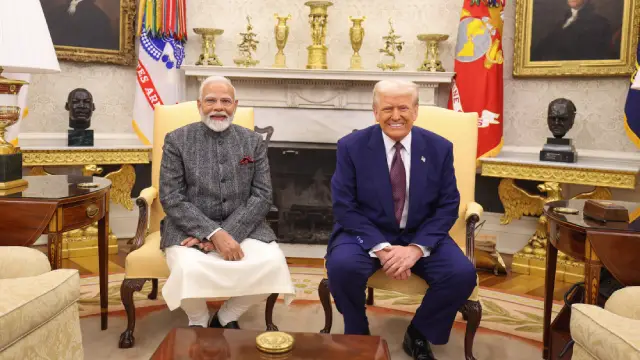
The dramatic reversal reflects mounting economic pressures from US President Donald Trump‘s punitive tariffs on Indian exports.
Mr Trump imposed 50% combined tariff rates on India, among the world’s highest, while accusing New Delhi of maintaining unfair trade practices.
This economic coercion appears to have forced India toward diplomatic positions that undermine its carefully cultivated Western partnerships.
Modi’s support for Tianjin Declaration reverses previous pro-Israeli positions
The Tianjin Declaration contains explicit condemnations of Israeli military aggression on Gaza that represent a fundamental departure from Mr Modi’s recent stance.
The document states that member countries “resolutely condemn actions that have led to numerous casualties among the civilian population and a catastrophic humanitarian situation in the Gaza Strip”.
The declaration demands an immediate and complete ceasefire in Gaza while criticising Israel’s use of starvation as a weapon against civilians.
This represents a striking reversal from India’s position following the October 2023 Hamas-led Operation Al-Aqsa Flood and the subsequent Israeli aggression.
Mr Modi immediately condemned Hamas‘s actions as “terrorist” while expressing “solidarity with Israel”, notably avoiding any mention of Palestinian casualties.
Foreign Policy characterised this as “a seemingly dramatic shift in India’s stance toward the Israeli-Palestinian conflict” away from its historical pro-Palestinian positions.
Mr Modi, however, has ensured that the SCO summit didn’t mention Israel’s aggression as “genocide”, a position New Delhi has held since the beginning.
It appears that India’s move is driven by the fact that Benjamin Netanyahu is set to visit India later this year and meet Mr Modi, who is going to apparently hug his Israeli counterpart.
India’s ties with Israel in a myriad of fields, from defence to technology, from water to agriculture, have strengthened under Mr Modi, and the prime minister is in no mood to disrupt the equation.
Amid this, the shift in India’s stance, from mildly criticising the violence in Gaza, from calling for an end to the conflict and advocating the formation of a free Palestinian state as the ultimate solution to the conflict, to one where Israel is strongly condemned, appears to be Mr Modi’s compulsive retreat in the given geopolitical situation.
Moreover, that’s not the end.
Endorsed by Mr Modi, the Tianjin Declaration goes further, condemning joint American-Israeli strikes on Iran in June 2025.
The document states, “The member states resolutely condemned the military strikes by the State of Israel and the United States of America against the Islamic Republic of Iran in June 2025.”
It describes these actions as “gross violations of the principles and norms of international law” that damage regional and international security.
This condemnation proves particularly significant given India’s explicit refusal to participate in similar SCO statements just months earlier.
In June 2025, India’s Ministry of External Affairs stated it “did not participate in discussions” on condemning Israeli strikes against Iran.
Al Jazeera noted this weakened the SCO’s collective stance, positioning India as an outlier within the China-Russia-dominated bloc.
Economic pressures drive Modi’s support for Tianjin Declaration
The timing of India’s diplomatic shift coincides with escalating trade tensions with the United States.
Mr Trump imposed combined tariff rates of 50% on Indian exports, affecting sectors worth $48.2bn, including textiles, gems and jewellery.
The Trump 2.0 administration explicitly linked these measures to India’s continued purchases of Russian oil, with Mr Trump calling India-US trade relations “a totally one-sided disaster” following Mr Modi’s China visit.
These economic pressures create severe vulnerabilities for India’s export-oriented industries that aspire to grow.
The country maintains a healthy $41.18bn trade surplus with America through total bilateral goods trade worth $128.9bn.
At the same time, India faces a massive $99.2bn deficit with China despite a total trade of $127.7bn.
This asymmetric dependence forces difficult choices between economic survival and strategic alignment.
India can’t say no to Chinese imports as they are crucial for its industries, a reality that compelled Mr Modi to break the ice with China in October 2024.
At the same time, he can’t ignore the trade surplus with the US, as it’s an impetus for the country’s export-oriented industries, which his government claims to support.
CNBC reported Mr Trump’s threat that India-US trade represents “a totally one-sided disaster” requiring immediate correction through tariff measures.
The administration specifically targeted India’s energy relationship with Russia, demanding New Delhi choose between American market access and affordable Russian oil supplies.
Facing potential loss of $36.5bn in exports and hundreds of thousands of manufacturing jobs, India appears to be hedging its strategic bets.
Moreover, Indian businesses have over $40bn in investments in the US, with new investments promised during Mr Modi’s February tour.
The US also ranks third in the list of countries from where foreign direct investment (FDI) came to India in 2024-25. The total FDI contribution of the US was 11%, according to the government’s data.
Modi’s support for the Tianjin Declaration also addresses economic coercion directly, with member states opposing “unilateral coercive measures, including those of an economic nature, contrary to the UN Charter”.
This language clearly references American tariff policies whilst providing India diplomatic cover for its policy reversals.
Modi’s Hindu nationalist concerns surface in Tianjin Declaration context
The declaration’s condemnation of “xenophobia, racism, nazism and neo-nazism” creates particular difficulties for Mr Modi’s far-right Bharatiya Janata Party (BJP).
Western human rights organisations have extensively documented the BJP’s promotion of Hindu supremacist ideology through its parent organisation, the Rashtriya Swayamsevak Sangh (RSS).
The BJP and the RSS have managed to polarise India’s majority Hindu community against its largest minority community, the Muslims.
By fuelling xenophobia and misinformation, hundreds of radical and militant Hindutva groups have been carrying out mob violence targeting minority Muslims and Christians in India.
Inspired by the Nazi ideology, the RSS has always advocated for a state that resembles the Third Reich in India.
However, for years, the West has remained a mute spectator in its bid to appease Mr Modi.
Human Rights Watch has criticised European leaders for overlooking “growing abuses and discriminatory policies” under Mr Modi’s government.
The organisation warned that “quiet diplomacy has had no evident impact” on India’s treatment of religious minorities.
Amnesty International’s European office has called for stronger EU action on India’s human rights record, specifically citing concerns about the systematic marginalisation of India’s 200 million Muslims.
Academic analysis from institutions including Princeton University and King’s College London documents what scholars term “democratic backsliding” under Mr Modi’s leadership.
The Journal of Democracy published research comparing India’s current policies toward Muslims to “Jim Crow era segregation policies” in the American South.
The controversy surrounding textbook content in Gujarat, Mr Modi’s home state, adds complexity to the Tianjin Declaration’s anti-Nazi language.
The BBC reported in 2005—when Mr Modi was the state’s chief minister—that human rights campaigners condemned school textbooks which “praise Hitler” with books issued by the state government including chapters on “internal achievements of Nazism”.
The World Jewish Congress documented Gujarat textbooks praising Hitler as having “made a strong German organisation with the help of the Nazi party and attained great honour”.
Mr Modi’s BJP, and its parent body RSS, manage an extremely difficult balancing act.
On the one hand, they support and hail Nazi Germany and its so-called achievements, on the other, they vehemently advocate for the Jewish homeland in occupied Palestine.
This janoos-faced approach, which stems from ideological fluidity, makes it easier for Mr Modi to endorse anti-Nazi diplomatic rhetoric while practising the opposite at the same time.
Strategic contradictions undermine India’s multi-alignment approach
Though Mr Modi joined others in signing the Tianjin Declaration, the latter highlights fundamental contradictions in India’s “multi-alignment” strategy.
While endorsing SCO positions that explicitly target American and Israeli policies, India simultaneously maintains membership in the Quad alliance designed to counter Chinese influence.
The Georgetown Journal of International Affairs describes the Quad as seeking to “shape the Indo-Pacific in a manner favourable to its members at a time when China is striving for regional dominance”.
Just when Mr Modi was signing the Tianjin Declaration, an Indian Army contingent reached Fort Wainwright in the US’s Alaska to participate in the 21st edition of the India-US Joint Military Exercise “Yudh Abhyas 2025”.
Before coming to China, Mr Modi visited Japan to emphasise India-Japan collaboration in the “Indo-Pacific”, which aims at curbing China’s influence in the region.
India’s military cooperation with Japan has expanded dramatically, including reciprocal base access agreements and joint exercises across air, land and sea domains.
The Council on Foreign Relations notes China’s Foreign Ministry views the Quad as an “anti-China front line”, while former secretary of state, Mike Pompeo, admitted the grouping would ensure “China retains only its proper place in the world”.
Asia Times analysis characterises India’s position as that of a “Trojan horse” within organisations like SCO and BRICS, noting “the Global South watching very keenly how India is acting more like a client state of Western neocolonialism than a supposed leader of Global South”.
This assessment reflects growing scepticism about India’s commitment to genuine multipolarity versus tactical opportunism.
The contradiction extends to defence relationships, with India becoming Israel’s largest weapons buyer at $2.9bn over the past decade, according to The Times of Israel.
This military partnership sits uneasily with Mr Modi’s endorsement of the Tianjin Declaration’s criticism of Israeli policies, suggesting India’s positions reflect economic necessity.
European scepticism grows toward Modi’s democratic credentials
European institutions have documented mounting concerns about India’s democratic trajectory under Mr Modi’s leadership.
The European Parliament adopted resolutions in January 2024 raising “urgent human rights concerns, including violence, increasing nationalistic rhetoric and divisive policies against minorities”.
Multiple European human rights organisations have called for stronger EU action on India’s deteriorating rights record.
The controversy surrounding the BBC documentary “India: The Modi Question” highlighted these tensions when the Indian government used emergency powers to ban its broadcast.
The documentary examined Mr Modi’s role in the 2002 Gujarat riots, leading to government raids on BBC offices and criticism from press freedom organisations.
NPR reported that “press freedom in India has declined under the Modi government” with systematic targeting of critical journalism.
Modi’s support for the Tianjin Declaration’s embrace of positions previously rejected by India suggests a government willing to abandon certain public stances when economic interests demand tactical flexibility.
This opportunistic approach reinforces concerns about New Delhi’s attempts to maintain relationships with competing power blocs.
At the end of the day, India’s much-hyped “strategic autonomy” is sans principles.
While it’s a policy of convenience, the partners whom Mr Modi tries to appease the most cause more harm to India’s long-term interests.
The combination of Mr Trump’s economic pressure, China’s growing assertiveness and Mr Modi’s domestic Hindu nationalist agenda creates a complex matrix where India’s traditional non-alignment philosophy faces unprecedented stress.
In this context, Mr Modi’s support for the Tianjin Declaration may mark a turning point. However, due to the economic realities and long-term dependence on the West, New Delhi won’t ever drift away from the Atlantic’s coast.
East Post is an independent geopolitical analysis portal covering South Asia and global power dynamics for international audiences. Views expressed are analytical and do not constitute endorsement of any state or non-state actor.
Join our channels on Telegram and WhatsApp to receive geopolitical updates, videos and more.