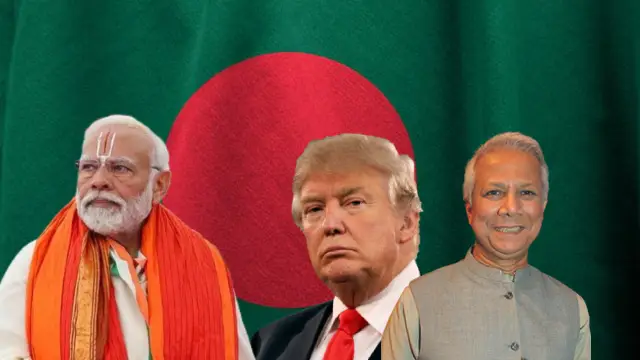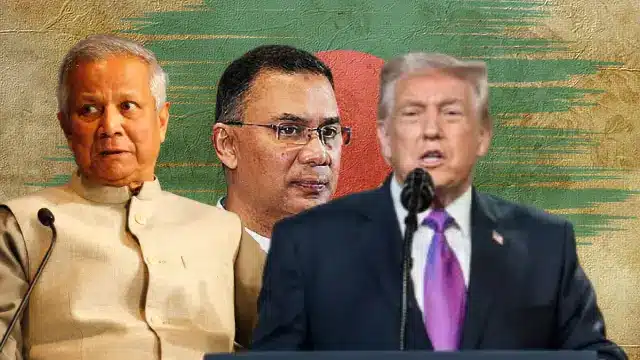
A 37% tariff hangs over Bangladesh’s exporters if the upcoming Bangladesh Nationalist Party (BNP) government signs any fresh trade deals with what the US calls a “non-market economy”. In return, Bangladesh gets tariff relief and market access. But it gives up room to manoeuvre. This is a concerning conclusion of the Bangladesh-US trade agreement that the interim government has negotiated.
Bangladesh-US trade agreement blocks road to China
The new Bangladesh-US trade agreement prevents Dhka from striking trade arrangements with countries such as China or Russia.
The US can impose punitive tariffs if the BNP-led government tries to go ahead with any such bilateral measures.
While senior BNP leaders didn’t wish to comment on the party’s stance, as the US locks its trade and diplomatic sovereignty, the agreement effectively blocks Dhaka from pursuing free-trade agreements with those economies.
If Bangladesh signs a new agreement with a designated non-market economy and that deal harms American interests, Washington may scrap the pact.
It may also restore the reciprocal tariff rate set under Executive Order 14257 on April 2nd 2025.
The restriction may also complicate Bangladesh’s ambition to join the Regional Comprehensive Economic Partnership (RCEP), the world’s largest trading bloc. China is a member.
To join, Bangladesh would need separate agreements with each existing member.
The deal also casts doubt on Dhaka’s deepening economic ties with Beijing. This will hamper its technological and defence aspirations and make Dhaka rely solely on the US, the West, their allies and regional satrap India.
America already classifies several countries as non-market economies, including China and Russia, as well as Vietnam, Belarus, Tajikistan, Uzbekistan, Moldova and Azerbaijan.
As the BNP has been historically promoting the idea of an independent foreign policy of “friendship with all and enmity with none”, the US terms may cause major diplomatic hurdles.
The non-market clause sharply narrows Bangladesh’s policy options.
Russia ties, energy to suffer
The agreement also bars Bangladesh from procuring nuclear reactors, fuel rods or enriched uranium from any country that threatens fundamental US interests. It allows exceptions only if no alternative supplier exists or if contracts predate the deal.
This provision could affect the Rooppur nuclear power plant. Bangladesh would struggle to sign new supply or service agreements with Russia. The US will have greater authority over Bangladesh’s foreign policy and bilateral relations.
This can severely impact the South Asian country’s politics where the erstwhile Sheikh Hasina-led Awami League government was ousted through a popular uprising following allegations of mortgaging sovereignty through unequal deals with India.
Bangladesh-US trade agreement threatens investments
The agreement also covers investment. If a third-country firm invests in Bangladesh and exports goods to the US below market value, Washington may act against that company.
This term threatens Bangladesh’s economy.
It can’t woo manufacturing investments from China.
Earlier in March 2025, during his Beijing visit, interim government’s Chief Advisor Muhammad Yunus had paved the way for large-scale investments from China.
It has been assumed that China may use Bangladesh as a manufacturing hub to bypass US tariffs and European restrictions.
The agreement’s reach goes further. Even if a foreign investor in Bangladesh exports elsewhere at below-market prices and harms an American firm, the US may intervene.
Due to this clause, the Chinese and other investors may now hesitate to invest in Bangladesh. It will significantly affect employment creation opportunities.
Many Chinese firms had viewed Bangladesh as a low-cost base for exports to the US, which they may no longer do.
Moreover, the asymmetry in the Bangladesh-US trade agreement is exhibited in its colonial template.
The US has the explicit right to define “market rates”.
Dhaka can’t decide the same. Dhaka can’t restrict the US from signing bilateral deals with others.
Back in the 1990s, the US had imposed anti-dumping duties on Bangladesh.
Officials calculated market value by adding a 20% profit margin to production costs.
The nightmare returns in a big way.
Colonial hegemony
Dhaka appears toothless before the US if the fine print is read.
Still the outgoing interim government continues to project the deal as a victory.
The neo-colonial setup is evident from the fact that Dhaka will receive tariff concessions on 1,638 products. In return, it will cut duties on 6,710 American products.
Bangladesh has reduced tariffs on US goods by 50%. The cut applies to customs, supplementary and regulatory duties. Only VAT and advance income tax remain unchanged.
Due to these measures, Bangladesh’s revenue income from duties may fall.
Domestic industries may face stiffer competition.
Agriculture may see crisis escalation.
On intellectual property, Bangladesh must sign 13 agreements beyond the WTO framework.
Adjusting domestic law and industry to meet those standards will not be easy.The broader pattern is hard to miss.
Bangladesh secures access to the US market. But at what costs?
It accepts limits on whom it may trade with, what it may buy and how it may regulate. The tariff carrot comes with a strategic stick.
The only gain that the interim government could underscore is a 0% tariff on certain readymade apparels.
However, for them, Bangladeshi producers have to buy US cotton and fibres, which are more expensive than those sourced from India or Pakistan. This will further curtail profitability for exporters and, in the long run, impact the economy.
Now, as Mr Yunus exits after finalising the Bangladesh-US trade agreement, it remains to be seen whether the BNP-led government ratify the treaty or seeks a re-negotiation to adhere its “Bangladesh first” foreign policy.
As for the Islamist right-wing, which had been vocal against what they called Indian colonial hegemony during Ms Hasina’s rule, the involvement of the US brings an ominous silence.
Its anti-colonial intellectual voices and street mobs have chosen to look away as sovereignty faces a tough challenge.
East Post is an independent geopolitical analysis portal covering South Asia and global power dynamics for international audiences. Views expressed are analytical and do not constitute endorsement of any state or non-state actor.
Join our channels on Telegram and WhatsApp to receive geopolitical updates, videos and more.