Facing the biggest student-led protest of his third term, Indian Prime Minister Narendra Modi has reshuffled the bureaucracy overseeing India’s examination system, rather than accepting the Cockroach Janata Party’s (CJP) central demand—Education Minister Dharmendra Pradhan’s resignation.
Senior Bharatiya Janata Party (BJP) sources say the government has ruled out removing Mr Pradhan. Their reasoning is political rather than administrative. The decision, they say, reflects calculations within the party’s Odisha leadership rather than an assessment of the Union minister’s handling of the question paper leak crisis.
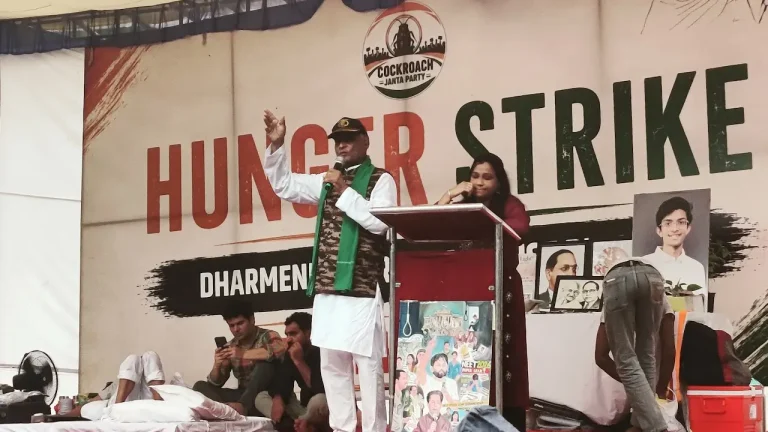
On July 24th, after Sonam Wangchuk ended his 26-day hunger strike following government assurances of fast-track courts for paper leak cases, CJP agreed to hold talks with government representatives at Delhi’s Constitution Club. The meeting failed to ease immediate tensions, although it broke the ice between the two sides. Whether it addresses the movement’s principal demand—Mr Pradhan’s resignation—remains uncertain.
Bureaucratic reshuffle instead of political accountability
The government’s immediate response has focused on Indian Administrative Service (IAS) bureaucrats rather than elected leadership.
On Thursday, July 23rd, it appointed Naresh Pal Gangwar as secretary of the Department of Higher Education and TK Anil Kumar as secretary of the Department of School Education and Literacy. Officials have presented the appointments as part of efforts to restore confidence after repeated examination paper leaks.
The reshuffle does not address the demand that has defined the protests since they began—Mr Pradhan’s resignation.
The distinction is significant. The CJP and protesters argue that administrative changes cannot substitute for ministerial accountability if the political leadership remains unchanged.
However, the bigger trouble for Mr Modi’s government is the choice of IAS officials for the ministry. Both Mr Gangwar and Mr Kumar have allegations of corruptions against them.
Questions over new appointments
Mr Gangwar, a 1994-batch IAS officer, previously served as secretary in the Ministry of Fisheries, Animal Husbandry and Dairying. An investigation published by The Indian Express in June 2026 alleged that his mother, wife and son received more than Rs 11.6m in subsidies under a Union horticulture scheme over five years.
Mr Kumar has faced separate allegations dating back to his tenure in Karnataka. Karnataka Administrative Service officer K Mathai accused him and other IAS officers of harassment, withholding salary and ordering a retaliatory transfer. Although the Karnataka Lokayukta dismissed the complaint, Mr Mathai later approached the Karnataka State Human Rights Commission in 2019, alleging he was targeted after exposing an alleged Rs 3bn land allocation scam involving the Mandya Urban Development Authority. He says he was transferred 27 times over a decade.
Neither set of allegations has resulted in a court finding against the officers. Both, however, are likely to attract scrutiny given the government’s stated objective of restoring public confidence in the examination system.
Protesters question government’s approach
The appointments have prompted fresh criticism from CJP.
The government has repeatedly promised strict action against those responsible for examination paper leaks. Protest leaders argue that appointing officials who have previously faced allegations, even if those allegations remain unproven, weakens that message.
Officials within the education ministry also privately suggest the reshuffle may serve another purpose—shifting administrative responsibility for the examination crisis without addressing broader political accountability. Those claims could not be independently verified.
Why Pradhan remains in office
According to senior BJP sources, Mr Pradhan’s position is tied to political calculations in Odisha.
The sources say removing him from the Union cabinet could revive speculation about his future role in state politics, potentially creating friction with Chief Minister Mohan Majhi. Such a development, they argue, could complicate the BJP’s efforts to consolidate support among tribal voters following its first electoral victory in Odisha.
The BJP has not publicly linked Mr Pradhan’s position to these considerations. If the sources are accurate, however, the government’s reluctance to remove the education minister reflects internal political priorities rather than the examination controversy itself.
From courtroom remark to nationwide protest
CJP emerged from an episode unrelated to examination policy.
The movement began after reports that Chief Justice of India Surya Kant described unemployed young people entering activism and journalism as “cockroaches” and “parasites of society”. Communications strategist Abhijeet Dipke adopted the phrase as political satire, creating the Cockroach Janata Party.
The movement gained momentum after the alleged leak of the National Eligibility cum Entrance Test (NEET) paper following the examination held on May 3rd, 2026.
The NEET was conducted again on June 21st. Participation fell from about 2.2m candidates in May to 1.99m in June, with more than 205,000 candidates choosing not to appear. Protesters cite the decline as evidence of eroding confidence in India’s examination system.
Hunger strike ends, negotiations begin
The immediate confrontation eased this week.
Mr Wangchuk ended his 26-day hunger strike on July 24th after Mr Modi and his government announced plans to establish fast-track courts to prosecute those accused of leaking examination papers.
Mr Modi announced the decision through a short video released on social media on July 23rd. The announcement addressed prosecution of alleged offenders but did not respond to demands for Mr Pradhan’s resignation.
Government representatives and CJP leaders have now agreed to begin formal discussions.
The talks may reduce immediate political pressure on the government. They are unlikely, however, to resolve the movement’s central grievance unless the question of political accountability is addressed. For CJP, the issue extends beyond examination reform. It argues that responsibility for the crisis ultimately rests with the minister overseeing the education system.
East Post is an independent geopolitical analysis portal covering South Asia and global power dynamics for international audiences. Views expressed are analytical and do not constitute endorsement of any state or non-state actor.
Join our channels on Telegram and WhatsApp to receive geopolitical updates, videos and more.