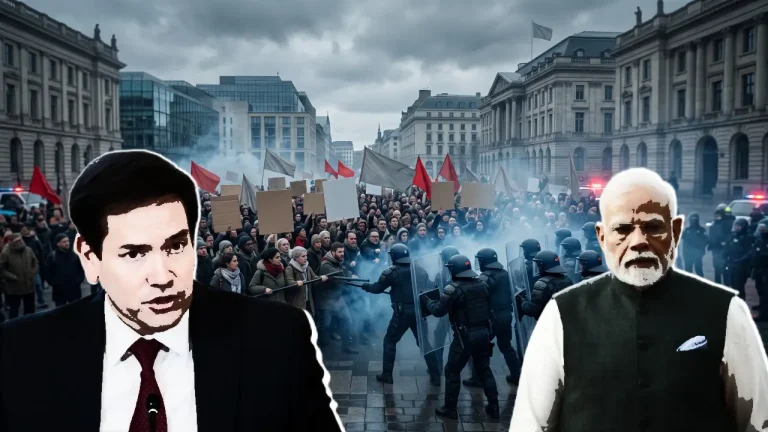
Washington, DC, Mayor Muriel Bowser is often accused of balancing between left-wing policies and a right-wing president in the White House. However, when she issued a severe heat warning for July 16th, little did she imagine that events in the capital city would raise the political temperature. The catalyst was Secretary of State Marco Rubio, who chaired the Ministerial on the Resurgence of Political Terrorism at the Loy Henderson Conference Room on that day. This meeting aimed to include “left-wing extremism” into the ambit of the US’s anti-terror drive, prompting a major backlash from critics around the world who accused President Donald Trump’s administration of redefining terrorism to suit its political agenda.
Mr Trump’s government, however, isn’t the sole player in this game.
Ministerial representatives from over 60 countries, including those from Argentina, India and Israel, participated in the Ministerial on the Resurgence of Political Terrorism, where Mr Rubio lambasted “left-wing extremism”, calling it an imminent threat not just for the US, but for the world.
The new terminology of “political terrorism” has revived the debate over politicising the overall global efforts to counter terrorism. It has again raised the old question — whether the US’s overall approach towards terrorism is driven by its alleged double standards?
“For far too long, however, our counterterrorism doctrine has had a blind spot – a blind spot when it comes to extremist violence from the political left,” Mr Rubio said. He alleged, “Even today, the very idea that far-left terrorism could be a serious threat is treated as a right-wing fever dream, or worse, as a dangerous fascist conspiracy. It’s treated this way by many in the press, by many in academia and our universities, and by many of our legacy institutions.”
He accused think-tanks dealing with the threat posed by terrorism and extremism of dismissing the left-wing extremist threat. “A bomb planted by a neo-Nazi group was a nefarious and murderous act of evil. It is. But a bomb planted by a Marxist revolutionary – well, that’s just merely a tragic excess of idealism. Perhaps its means were misplaced or overzealous, but its ends were virtuous and just. That’s the implication of how they treat it,” the secretary alleged.
While he placed his arguments before the participants, his opponents raised a question — why is the world’s largest counterterrorism power suddenly redefining terrorism?
For geopolitical experts, there is nothing new in Mr Rubio’s claims.
This may look like a dramatic policy shift. Yet evidence suggests Washington is entering a debate that has already unfolded elsewhere.
Consider the fact that soon after Israel launched attacks on the Gaza Strip in October 2023, countries like France and Germany banned protests and clamped down on Palestine supporters quickly. No allegations of bias changed the European states’ approach towards the protesters.
In India, under the pretext of combating left-wing extremism, successive governments have clamped down on genuine democratic dissent, the left forces within and outside the Parliament have alleged. Critics also argue that New Delhi has criminalised dissent using a controversial law —the Unlawful Activities (Prevention) Act (UAPA).
While the government justifies using UAPA for the sake of national security, critics argue that these actions undermine democratic processes and curb people’s constitutional rights.
Against this backdrop, Mr Rubio’s doctrine looks less like a beginning than another stage in a wider democratic debate.
‘Nothing new’ in Rubio’s political terrorism and left-wing extremism rhetoric
Discussing the geopolitical significance of Mr Rubio’s allegations and Mr Trump’s administration’s attempts to broaden the scope of counter-terrorism by including “left-wing extremism” under the “political terrorism” category, Jason Zaharis, an American journalist and geopolitical expert, told East Post that Washington has been trying to expand the definition of terrorism for decades.
“It’s that drive that ultimately led to the ‘Red Scare’, the imprisonment of Julian Assange and Eugene V Debs, and the passage and weaponisation of various laws, such as the Espionage Act and Patriot Act,” he said.
India’s experience with ‘left-wing extremism’: When counterterrorism becomes political language
Though the British model shapes India’s polity, Prime Minister Narendra Modi lauds the country as the “mother of all democracies”. Yet this “mother” has been treating dissent with sheer hostility over the years, according to political experts.
Mr Rubio’s call in Washington to include “left-wing extremism” as a threat under the “political terrorism” category is something that the Indian left has been experiencing for decades.
India launched a military campaign against left-wing extremism from 1967 onwards, when a peasant rebellion in a small hamlet in the foothills of the eastern Himalaya, called Naxalbari, turned into an uprising across the countryside of its eastern coast and northern plains.
Popularly known as the Naxalite movement, the far-left movement was categorised as the single biggest threat to national security under former prime minister Manmohan Singh in 2005.
On October 19th, 2006, the Union Ministry of Home Affairs established a new division to address left-wing extremism in India.
Although initially the target was to combat the threat posed by the armed movement waged by the Communist Party of India (Maoist) [CPI(Maoist)], which resorted to violent acts targeting the police and public infrastructure in central and eastern parts of India, later, activists and critics allege, it started targeting the broad spectrum of left-wing opposition and civil activists.
Initially, P Chidambaram, a leader of the centre-right Indian National Congress (INC) and home minister from November 2008 to July 2012, amended and tightened the UAPA’s clauses to use it against left-wing forces. Still, it became far more draconian under Mr Modi.
Mr Modi’s government further amended the UAPA in 2019, which, critics argue, further shrank the space for dissent and turned it into an institutional tool to target activists and critics.
The Modi government has emphasised “national security” as one of its principal goals, which aligns with the approach of most far-right governments. Yet critics allege that the “national security” parameters remain highly partisan.
Mr Modi’s ruling Bharatiya Janata Party (BJP) traces its ideological roots to the 100-year-old Rashtriya Swayamsevak Sangh (RSS), a Hindu nationalist organisation that has long viewed communist movements as ideological adversaries. Critics argue that this ideological contest has increasingly shaped the government’s rhetoric on national security and dissent, a claim rejected by the ruling party.
Scores of activists, writers, journalists, students and others remain imprisoned under the UAPA, prompting international criticism. The BJP and RSS have used the “urban Naxal” label and the “left-wing extremism” lens to deal with all popular unrest and protests, the Opposition, including the INC, argues.
Against this backdrop, while Mr Rubio’s emphasis on “political terrorism”, including “left-wing extremism”, appears something new to the American mainstream media, for Dipankar Bhattacharya, the general secretary of CPI (Marxist-Leninist) Liberation [CPI(M-L) Liberation], it’s a part of Indian left’s quotidian existence.
Speaking to East Post on Mr Rubio’s meeting on “political terrorism” for including “left-wing extremism” as a threat to national security, Mr Bhattacharya said, “There is nothing unusual or unexpected about it, especially for us in India. For the last 12 years, during the Modi era, every dissent and dissenting voice has been dubbed ‘urban Naxal’.”
He alleged that the Modi government “openly considers and treats the left ideology as something ‘anti-Indian’, ‘anti-national’, and ‘foreign inspired’”, adding that this is the official ideology of New Delhi, which is also the ideology of Washington.
The CPI(M-L) Liberation leader alleges that the new developments in Washington are linked to the new “Red Scare” following the growing popularity of left and socialist movements in the US.
“After a long time, there is a lot of socialist-like dissent within America. A lot of young, new politicians are coming up and winning elections—Zohran Mamdani and so many others. It’s now a trend in America,” he claimed.
“So they are trying to invoke this anti-communist myth to rally support around the Trump regime, which is losing credibility very fast. And the other thing is, globally, it is the far-right. Everybody talks about the resurgence of far-right, fascist violence across Europe. This is the dominant threat to democracy internationally,” Mr Bhattacharya said, adding, “This is a manufactured kind of myth to protect and promote far-right aggression across the world.”
On August 3rd 2022, the United Nations’ Secretary-General António Guterres presented a report to the United Nations Global Counter-Terrorism Strategy. The report underscores that far-right violence is becoming a threat to global peace.
The report claimed that “terrorist attacks on the basis of xenophobia, racism and other forms of intolerance, or in the name of religion or belief,” are considered by several member states “to be the fastest growing or even most prominent domestic security threat they face”.
Mr Bhattacharya’s allegations against far-right forces raise concerns that remain unanswered in the national security doctrines of India and the US.
The Modi government crackdown on dissent aren’t unique.
“In the case of the United States, Nelson Mandela was considered a terrorist; the FBI surveilled Martin Luther King for civil rights activism; and labour activists like William Z Foster were imprisoned under the unconstitutional Smith Act, which made it a crime to call for regime change in the US,” Mr Zaharis told the East Post.
While both Mr Bhattacharya and Mr Zaharis emphasise that the trend isn’t unusual or new, they point to a broader issue that transcends the Atlantic.
America’s war against terror raises questions
Their arguments reflect a broader debate over whether Washington’s counterterrorism policies have consistently distinguished between security threats and geopolitical objectives.
Talking about how the ministerial meeting on “left-wing extremism” can influence domestic security doctrines of other countries, Mr Zaharis adds, “Countries around the world are starting to realise that the US and Europe are the world’s leading state sponsors of terrorism, whether it be the Mujahideen in Afghanistan, Al Qaeda and ISIS in Syria and West Africa, the NATO bombings of Yugoslavia and Libya, or the Israeli genocide against the people of Gaza.”
“The ‘War on Terror’ was simply a disguise for the US as they carried out their five-year regime change plan against West Asian governments that were sworn enemies of jihadism,” Mr Zaharis alleged.
Mr Bhattacharya, at the same time, doubts Mr Rubio’s actions as a precursor to an attack on Cuba. “They are trying to build an environment to attack Cuba,” he alleged.
“After Iran, the next target is Cuba. And because of that, I think they are creating this kind of a global environment,” he added.
Is left-wing extremism becoming next global security doctrine?
Does evidence support Mr Rubio’s political emphasis on treating “left-wing extremism” as a threat under the “political terrorism” category?
A 2022 research paper by Katarzyna Jasko, Gary LaFree, James Piazza and Michael H Becker has emphasised that far-right extremism poses a greater threat as conservatives are more prone to using violence against their adversaries than far-left activists, who, the paper claimed, are mostly open to new ideas and views.
Data from the research shows that out of 1,563 violent incidents between 1948 and 2018, far-right forces committed 59%, far-left forces committed 23.4%, and Islamists committed 17.6%.
A study by the Center for Strategic and International Studies (CSIS) has shown that from 2016 to July 2025, 152 far-right attacks in the US killed 112 victims, averaging 0.7 victims per attack. At the same time, 13 people lost their lives in 35 far-left attacks across the US, averaging 0.4 victims per attack.
According to the CSIS research, 25 jihadist terror attacks have killed 82 victims in the same period, with the highest kill ratio of 3.3 victims per attack.
The study claims that though historically far-right violence surpassed far-left violence across the US, since Mr Trump’s return to the White House in 2025, far-left violence has seen a spike.
Mr Zaharis accused the US and its Western allies of harbouring jihadist terrorism.
“For the United States, a terrorist is whoever threatens the global interests of Wall Street and the military-industrial complex. And when it comes to actual jihadist terrorism, Washington and its allies in Britain and Israel have been the leading state sponsors of terrorism from Operation Cyclone in Afghanistan to Operation Timber Sycamore in Syria,” he claimed.
Where are institutional safeguards?
Expanding counterterrorism doctrines inevitably raises another question—what institutional safeguards prevent democracies from criminalising legitimate political dissent?
Institutional safeguards are most important for ensuring that broader counterterrorism policies do not erode democratic freedoms. However, Mr Zaharis believes that such safeguards aren’t even there in the US, let alone in Global South countries.
“Such institutional safeguards don’t exist because the First Amendment has been completely tossed out the window,” he said, citing Julian Assange’s imprisonment and the Uhuru activists’ arrest.
“Their only crimes were doing journalism and protesting against the Biden Administration’s arming of the Nazi regime in Ukraine as it openly declares its ambitions to carry out genocide against the Russian people. And the ICC (International Criminal Court) is practically useless because it’s designed to target adversaries of the West on politically motivated charges, with Benjamin Netanyahu being the lone exception, while turning a blind eye to US war crimes,” he claimed.
“The only way democratic freedoms can be safeguarded is if there’s a popular regime change in the United States and those guilty of crimes against humanity are sent to prison,” he opined.
The experiences of India indicate that a state can always cross limits using “left-wing extremism” as a subterfuge to negate the democratic rights of the people.
The US and a few European governments have used similar mechanisms to tackle the surge of protests staged against Israeli attacks on Gaza. Students, youths, activists and intellectuals have faced police violence in the so-called havens of “free speech” and “democracy”, critics argue.
From its beginning, George W Bush’s “war on terror” drive, which was started after the September 11th, 2001, attacks on the US, has been accused of gross human rights violations — not only in the Global South, but also within the US.
Abdullah-al-Kidd, an American citizen who converted to Islam, was detained for 16 days without a charge in 2003, after the government failed to find evidence against him. They held him as a “material witness” in connection with another accused but later released him and never called him to testify.
Driven by the hope to prevent similar mistreatment of other Muslims in the US, Mr al-Kidd had filed a petition in the Supreme Court against former attorney general John Ashcroft.
However, the American Supreme Court ruled (8-0) that Mr Ashcroft was protected under immunity cover.
Several cases of state repression, targeted at specific groups, especially Muslims and immigrants, have been reported in the US, and the accused in most cases remain scot-free.
In India, 10,440 people were arrested under the amended UAPA on terrorism charges between 2019 and 2023, but only 335 were convicted. The law that Mr Modi’s government hails as an antidote to terrorism has a conviction rate of only 3.2%.
Most accused of terror charges in India, mostly Muslims, spend years behind bars without trials, and many of them are released after 10-12 years, without any compensation.
Following the 2021 crackdown carried out by India targeting several activists, Rupert Colville, spokesperson for the Office of the United Nations High Commissioner for Human Rights, had raised concerns over the misuse of the UAPA.
With Mr Rubio pushing the agenda of fighting “political terrorism”, questions arise over its fair course and institutional safeguards.
How can the US and Western democracies ensure that no innocents are punished for the incompetence of the security forces? How can safeguards be assured when the First Amended has been negated?
At a time when Mr Trump’s administration faces criticism from organisations like the American Civil Liberties Union over harsh policing and abductions by the Immigration and Customs Enforcement officials, questions arise over how the same government can protect the rights of those who may become victims of the new war on “political terrorism”?
As developments in India have shown that states often violate civil rights when national security policies are politicised, it remains unclear how other governments can adopt a similar framework and also protect their citizens’ interests in the long run.
Resurgent left, communists back in currency
Mr Trump comes from a generation that has grown up amid the Cold War. His critics, in the US and abroad, argue that he is increasingly importing Cold War-era anti-communist narratives and rhetoric to counter his opponents.
From calling Mr Mamdani a communist to labelling the Democrats as appendages of the Chinese Communist Party, Mr Trump’s political rhetoric has increasingly focused on communism.
Meanwhile, Mr Bhattacharya sees these developments as indications of the left’s resurgence.
“I think this, in a way, recognises the left’s growing role. All these years they have been saying ‘the left is over’, the ‘left is finished after the Soviet Union collapsed’. Now, after more than 30 years since the Soviet Union’s collapse, if once again they are reinvoking the so-called left danger, the first thing it tells is that the left is back in currency,” the CPI(M-L) Liberation leader asserted.
He further said, “And there is growing support for the left, popular support for the left across the world. So, the left should draw that strength. The left should not get afraid of it. It’s (the developments in the US) not going to threaten the left anyway.”
The communist leader said it’s a good thing that wherever people voice concerns and dissent against injustice and inequality, it’s dubbed “left”.
Dismissing the prospects of a threat posed by the US administration’s drive to criminalise left-wing dissent as extremism under the “political terrorism” category, Mr Bhattacharya said, “The left should take it as a point of victory. There is absolutely nothing to be worried about.”
What comes next?
When Mr Rubio’s speech on “political terrorism” and “left-wing extremism” ended on July 16th, he left a lot of unanswered questions in the room regarding the future course of action.
The State Department published Mr Rubio’s remarks and the ministerial’s broad objectives. What remains unclear, however, is how participating governments intend to define, identify and coordinate against what Washington now calls “political terrorism”.
The significance of the meeting may ultimately lie not in terms like “political terrorism” or “left-wing extremism”, but in whether governments begin applying it beyond acts of political violence to encompass broader forms of ideological opposition.
India’s experience, Europe’s recent debates over Gaza protest restrictions and Washington’s new initiative suggest that this is no longer merely an American conversation. It is becoming a global one.
East Post is an independent geopolitical analysis portal covering South Asia and global power dynamics for international audiences. Views expressed are analytical and do not constitute endorsement of any state or non-state actor.
Join our channels on Telegram and WhatsApp to receive geopolitical updates, videos and more.