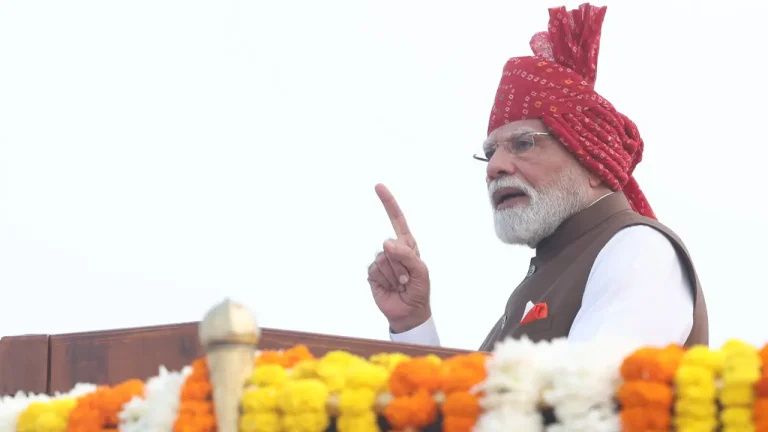
When Narendra Modi, India’s prime minister, unfurled the national flag atop the Red Fort in Delhi on August 15th for the country’s 80th Independence Day, the Bharatiya Janata Party (BJP) rushed out clips calling it a source of pride for all Indians. Mr Modi spoke, as he has before, of defence manufacturing and of building a developed India by 2047. What he did not mention is that his government has spent the past 18 months quietly conceding ground to Washington on trade, payments and diplomacy — the same ground his party claims, on occasions like this one, that India will never surrender.
वो लम्हा, जो हर भारतीय को गर्व से भर देता है… 🇮🇳
— BJP (@BJP4India) August 15, 2026
80वें स्वतंत्रता दिवस के अवसर पर पीएम श्री @narendramodi ने लाल किले पर तिरंगा फहराया। #IndiaIndependenceDay pic.twitter.com/91UPagdDKl
That contradiction is the story of Mr Modi’s second term with Donald Trump in the White House. The BJP insists India practises “strategic autonomy” in foreign policy. However, since Mr Trump’s return in January 2025, a series of bilateral concessions — on tariffs, digital payments, Gaza, and the fortunes of two politically connected Indian conglomerates — suggests that New Delhi has been managing Washington’s moods rather than setting its own terms. Rahul Gandhi, the leader of the opposition in the Lok Sabha, has said as much, accusing the government of lacking a coherent stance on almost every recent geopolitical flashpoint.
None of this fits comfortably with the imagery of August 15th. An examination of the past year and a half of policy decisions makes the gap between rhetoric and record hard to ignore.
Quiet reversal on digital payments
The most telling recent evidence is domestic, not diplomatic. During the monsoon session of Parliament, the government passed the Taxation and Other Laws (Amendment) Bill, 2026, amending the Payment and Settlement Systems Act, 2007. The amendment allows banks to levy charges on some transactions made via the Unified Payments Interface (UPI) — reversing a 2019 decision, taken by this same government, to waive merchant-discount-rate (MDR) fees on UPI and RuPay debit-card transactions.
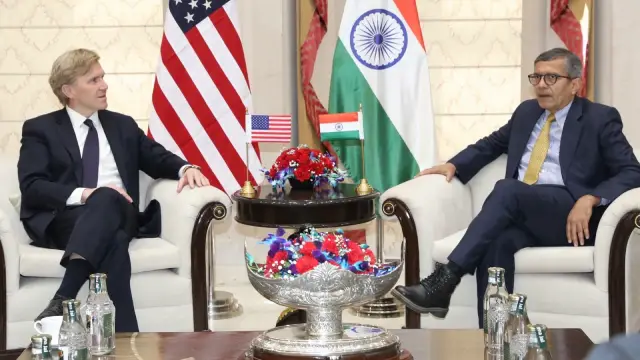
The government says ordinary retail transactions will be unaffected. Sceptics, including opposition figures and independent think-tanks, note that the United States Trade Representative (USTR) had previously flagged India’s zero-MDR regime as a trade barrier, arguing it disadvantaged American payment networks such as Mastercard and Visa, which face no such waiver in India.
The government denies any American hand in the policy change. It is nonetheless an odd position for it to arrive at unprompted: India’s banking sector was not pushing for the change, and it cuts against a decade of government boasting about UPI’s growth — from 2,539.56m monthly transactions worth Rs 4.90 trillion in May 2021 to 23,658.35m transactions worth Rs 29.88 trillion this July.
Ten years after Mr Modi’s demonetisation drive first pushed India towards cashless payments, his government is now taxing the system it built.
When national interest comes second
Mr Modi was among the first world leaders to court Mr Trump in his first term, culminating in the “Howdy Modi” rally in Texas in 2019 and “Namaste Trump” in Gujarat the following year. BJP leaders expected that closeness to carry into Mr Trump’s second term. It has not, at least not on India’s terms.
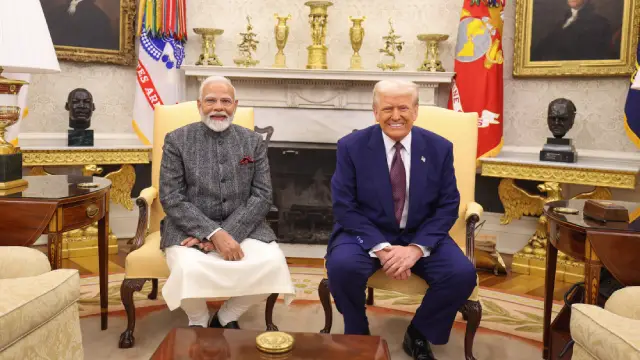
India reportedly could not secure Mr Modi an invitation to Mr Trump’s January 2025 inauguration despite lobbying for one. When Mr Modi visited the White House the following month, he came away, by several Indian accounts, having traded long-term concessions for the optics of the visit.
In May 2025, after a brief India-Pakistan military clash, Mr Trump claimed credit for brokering the ceasefire — a claim New Delhi disputed, but Mr Modi never directly rebutted, fuelling opposition claims that he was unwilling to risk the relationship by publicly contradicting the American president.
Then, in August 2025, the Trump administration imposed a 25% punitive tariff on top of an existing 25% base tariff on Indian exports — a combined 50%, among the highest rates faced by any major economy that year. Because America is India’s largest export market, Mr Modi’s government moved quickly to recalibrate trade policy in Washington’s favour.
A hastily concluded trade deal, agreed just before the US Supreme Court struck down Mr Trump’s underlying tariff authority as unconstitutional, is widely read in Delhi as a measure of how far India was prepared to bend. Negotiations over a fuller deal continue, and Indian farmers — organised under the Samyukta Kisan Morcha umbrella — have intensified protests against pressure to open the market to American farm imports.
In February 2026, the Indian National Congress (INC) staged a protest at the Parliament, calling the India-US deal a “trap deal”. The INC leaders alleged that the US president had used the controversial “Epstein Files” to pressure the Indian prime minister into agreeing to the deal. The INC president, Mallikarjun Kharge, had accused the prime minister of surrendering Indian interests under Mr Trump’s pressure.
Dependence deepens, autonomy shrinks
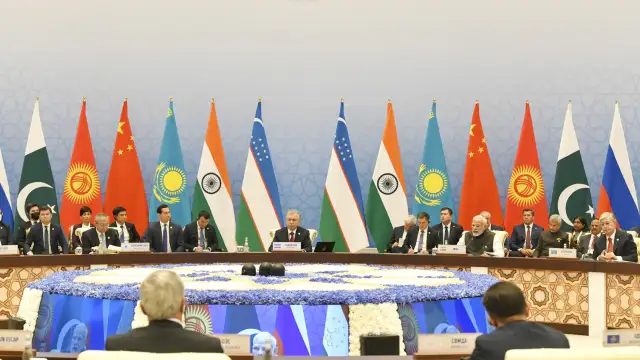
The pattern extends well beyond trade. Since 2014, Indian foreign policy has tilted rightward and westward even as the government continues to invoke “strategic autonomy” and a “multipolar world.” India remains a member of BRICS, the Shanghai Cooperation Organization (SCO) and the G20, but its actions increasingly track Washington’s preferences.
It has deepened its role in the Quad, the American-led grouping widely read as a check on China, and its 2020 border clash with Beijing — which critics link to pressure from the first Trump administration — cooled relations for years afterwards.
Only in 2024, at the BRICS summit in Kazan, did Mr Modi hold his first bilateral meeting with Xi Jinping since 2019; he visited China for the first time since the border clash the following year, attending the SCO summit in August 2025 even as Washington’s tariffs bit.
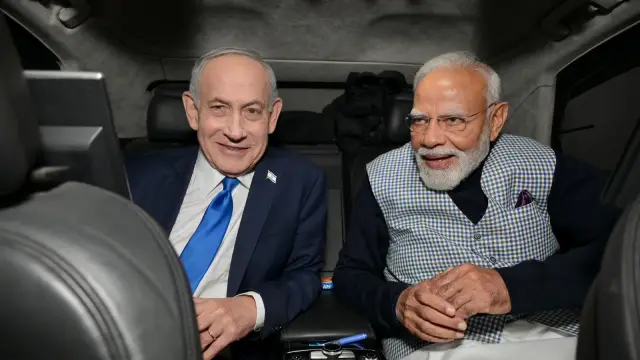
India’s position on Gaza tells a similar story. New Delhi abstained repeatedly on UN votes criticising Israeli actions in Gaza after the Hamas attacks of October 7th 2023, making it the only BRICS member not to criticise Israel’s conduct — a marked break from India’s traditional support for Palestinian statehood.
It offered only limited aid and occasional rhetorical nods to a “two-state solution.” India was similarly quiet on the 2025–26 US-Israeli strikes on Iran, a longstanding partner, speaking up only after Tehran’s retaliation rattled American forces in the region — and even then, condemning Iran’s response rather than the strikes that provoked it.
Critics see something more concrete than ideology behind these shifts: the commercial interests of two politically connected conglomerates whose fortunes have become entangled with India’s foreign-policy choices.
Corporate stake in India’s foreign policy
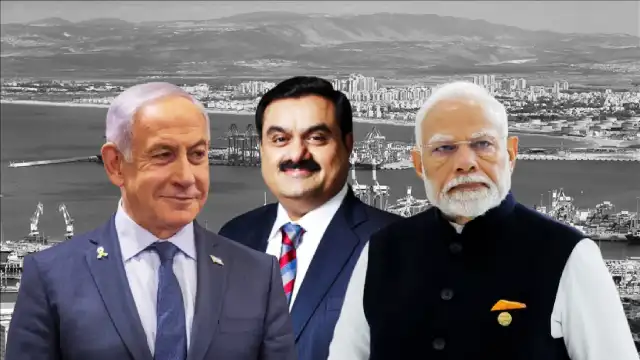
When India hosted the G20 in September 2023, Mr Modi backed the India-Middle East-Europe Economic Corridor (IMEC), a US-led alternative to China’s Belt and Road Initiative, routing cargo from South Asia to Europe, bypassing the Gulf of Aden.
Adani Enterprises, the ports-to-power conglomerate controlled by Gautam Adani — an industrialist the opposition has long accused of especially close ties to Mr Modi — sits at the centre of the project. Adani Ports owns Mundra Port in Gujarat, Mr Modi’s home state, and controls a majority stake in Haifa Port in Israel, positioning the group at both ends of the proposed corridor. Critics argue this gives the government a commercial reason to mute criticism of Israel, alongside any strategic one.
Mr Adani’s legal troubles in America add another layer.
The US Department of Justice charged him with bribery late in Joe Biden’s term; Mr Adani pledged more than $10bn in American investment and retained an attorney close to Mr Trump. Weeks before Mr Modi’s Independence Day address, the DoJ withdrew the charges — though the presiding judge, in permitting the withdrawal, raised pointed questions about both the department’s conduct and Mr Adani’s investment pledge.
The opposition alleges Mr Modi’s accommodation of American demands helped secure that outcome; the timing, at minimum, invites the question.
Mukesh Ambani, India’s richest man and head of Reliance Industries (RIL), presents a parallel case. Mr Ambani was a visible presence at Mr Trump’s 2025 inauguration, but the relationship soured when Mr Trump’s tariffs — imposed partly over India’s Russian oil purchases — hit RIL’s profitable trade in discounted Russian crude.
A meeting between the two families’ younger generations in Gujarat that November, reported by ProPublica, appears to have thawed relations: by February 2026, RIL had been cleared to refine Venezuelan oil following the American action against Venezuela, and in March, Mr Trump announced a $300m RIL investment in a Texas refinery — America’s first new one in half a century. ProPublica’s investigation found that Mr Trump’s son is an investor in the little-known start-up receiving RIL’s money, a project Wall Street has otherwise treated with scepticism.
Cost of chasing Washington
For years, Mr Modi has argued that his “strategic autonomy” doctrine has put India in its strongest global position in decades. The record increasingly points the other way. After Mr Trump’s May 2026 visit to China, Washington grew notably less enthusiastic about elevating the Quad to a head-of-state format — despite India’s investment in the grouping.
Within BRICS and the SCO, India continues to side with the Western bloc on most substantive questions and has shown no interest in the de-dollarisation efforts pushed by Russia, reflecting its continued dependence on the American and European markets.
Even as Mr Modi courts Mr Trump, Washington has drawn closer to Pakistan, folding it into the administration’s Gaza plan, crediting it with helping broker an Iran-US ceasefire, and admitting it to the Mecca Alliance, a Sunni military grouping aimed at isolating Iran. India’s proximity to the American-Israeli axis, meanwhile, left it without leverage when Iran closed the Strait of Hormuz after the 2025–26 strikes, disrupting the energy imports India depends on and helping drive domestic inflation — while China, thanks to its own ties with Tehran, avoided the worst of the disruption. Western human-rights and press-freedom bodies continue to rate India poorly on several measures, criticism the government routinely dismisses.
Gap that Independence Day can’t paper over
Mr Modi’s government came to office promising a foreign policy that would finally match India’s economic weight — one built on independence of action, not deference. What the record of the past 18 months shows instead is a government trading autonomy for access, one tariff exemption, trade concession and diplomatic silence at a time. None of these individual decisions looks catastrophic in isolation, which is precisely how such a shift tends to happen: not through a single capitulation but through a hundred small ones, each defensible on its own terms.
The test of “strategic autonomy” was never going to be how the doctrine is described on a stage at the Red Fort. It will be whether New Delhi can still say no to Washington when it matters. On the available evidence, that question remains open — and the pageantry of August 15th did nothing to answer it.
East Post is an independent geopolitical analysis portal covering South Asia and global power dynamics for international audiences. Views expressed are analytical and do not constitute endorsement of any state or non-state actor.
Join our channels on Telegram and WhatsApp to receive geopolitical updates, videos and more.