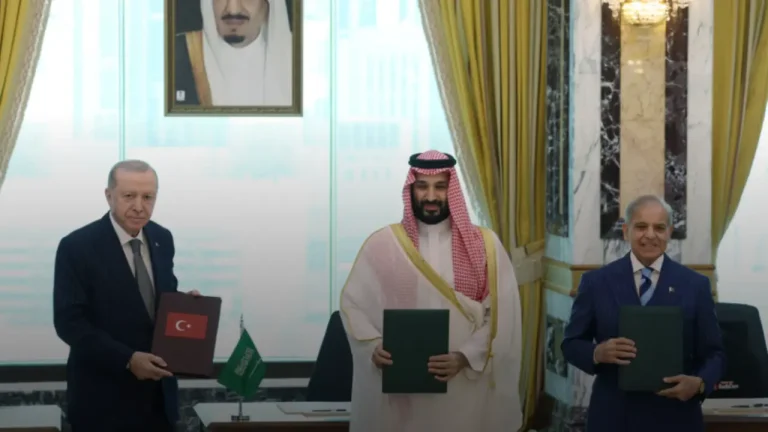
After Pakistan, Saudi Arabia and Türkiye signed the trilateral Mecca Defence Agreement, India finds itself in a tight spot. While there has been debate about the geopolitical positions Riyadh and Ankara might take in a conflict between New Delhi and Islamabad, one consequence has been largely overlooked: the near-impossibility of India countering this treaty’s repercussions for supply-chain choke points such as the Bab-el-Mandeb and the Strait of Hormuz.
In South Asia, the treaty could spark new tensions that disrupt supply chains, ultimately undermining American and European business interests in the subcontinent.
Yet India’s room for manoeuvre is limited. Narendra Modi‘s pro-Western foreign policy rules out several diplomatic options that might otherwise help New Delhi manage the fallout.
While India finds itself in trouble, the ripple effects can also affect Europe and the US.
Mecca Defence Agreement: Marriage of convenience
What made the three countries sign the Mecca Defence Agreement? The answer is straightforward: mutual convenience.
For Riyadh, Islamabad’s nuclear-power status is a crucial safety valve against Iran more than against Israel. For Pakistan, Saudi petrodollars are vital to its cash-strapped economy. For Türkiye, it is about enhancing its stature as a regional power, especially amid mounting tensions over Syria.
The Mecca Defence Agreement is a marriage of convenience, but it also carries risk for the region — particularly from an Indian perspective. That risk is not a direct military threat, since the pact does not threaten India’s security outright; rather, it revives a challenge that is not new for New Delhi.
Before the Mecca Defence Agreement, Pakistan and Saudi Arabia had already signed a mutual defence agreement in 2025, following Israel’s attack on Qatar.
Although New Delhi has been sceptical about Pakistan’s involvement in a crucial military pact in West Asia, it recognises that such pacts will not function like NATO, the transatlantic alliance.
An attack on one party — especially Pakistan — will not automatically mean an attack on the other two.
The Mecca Defence Agreement will not act as a “West Asian NATO” because, unlike the eight-decade-old transatlantic alliance built during the Cold War against the Soviet-led communist bloc, the tripartite agreement is not backed by dedicated troops, shared logistics and supply chains, or a unified command structure. Such capabilities cannot be built overnight, nor assembled ready-made.
Speculation has focused on whom the Mecca Defence Agreement is meant to deter.
Some geopolitical analysts believe it is Israel. The initial Riyadh-Islamabad alignment followed Israel’s attack on Qatar, and these analysts see the pact as a joint effort to deter Israeli expansion in the region — a reading they say is reinforced by Israeli Prime Minister Binyamin Netanyahu‘s recent criticism of Türkiye.
However, Donald Trump‘s support for the bloc suggests the Mecca Defence Agreement does not have Israel in its sights. Such a possibility would have alarmed Washington, and the treaty probably never would have been signed.
Rather, Mr Trump’s support highlights that the pact is not directed against an American ally. If it is not aimed at Israel, then who is it targeting?
The answer is not even India. Instead, it points to Iran — a country regarded as a common foe by both Saudi Arabia and Türkiye, according to regional analysts.
This complicates matters for India, which has been locking horns with Pakistan, strengthening ties with Israel, and keeping Iran at arm’s length.
New Delhi, some analysts believe, also sees the Mecca Defence Agreement as an extended military entente against Iran and its Axis of Resistance — one designed to help America and Israel in the long run.
This spares India from contending with three separate adversaries at once. However, it also creates serious problems of its own.
Mecca Defence Agreement sounds terrorism alarm
India has long accused Pakistan of using cross-border terrorism as an instrument of state policy. Bilateral relations between the two nuclear-armed neighbours remain frozen because of the Pahalgam terror attack on April 22nd 2025 and the four-day border conflict that followed.
Pakistan, however, accuses India of funding terrorists in its restive Balochistan province, where Gwadar port is located. Attacks by Balochistan separatists and the Tehrik-i-Taliban Pakistan (TTP) near the Afghan border have struck Pakistani soldiers, police and civilians.
Although India supports the Baloch liberation movement, it denies any role in sponsoring terrorism in Pakistan.
Amid these mutual accusations, the Mecca Defence Agreement raises the risk of terrorist activity in India, Pakistan and Iran’s Sistan-Baluchestan province. In August, Iran’s Islamic Revolutionary Guard Corps (IRGC) killed several militants in Sistan-Baluchestan, alleging links to Pakistan-based groups.
While Pakistan blames India and Israel for funding the Balochistan Liberation Army (BLA), Iran accuses Pakistan of harbouring Sunni militant organisations such as Jaish al-Adl, which it links to Salafist currents associated with Saudi Arabia. To counter them, Iran has allegedly funded Shiite militias in Balochistan province. The emergence of Shiite outfits such as Liwa Zainabiyoun and Lashkar-e-Sarullah has shifted the balance, since Pakistani intelligence considers these arms of the Iran-led Axis of Resistance.
Following the American-Israeli strikes on Iran in 2025, Pakistan has seen a rise in Sunni Islamist militant activity, including joint attacks by the TTP and BLA. Some reports suggest the BLA and TTP have endorsed the American-Israeli campaign against Iran. Tehran has also long accused Jaish al-Adl of being a front for Mossad, Israel’s intelligence agency.
BLA members say they seek Israeli and American support, arguing that a liberated Balochistan could give Washington greater leverage over the Strait of Hormuz and significantly weaken Iran. This poses a significant risk for the IRGC, which has to face dual challenge of fighting the US-Israel nexus and the foreign-funded terrorists.
As militants on both sides of the Iran-Pakistan border receive alleged American and Israeli backing to destabilise Iran, New Delhi’s bilateral ties with Tehran are put at risk. Iran may come to see India as complicit in this campaign to weaken it, which could end Iran’s neutral role in India-Pakistan conflicts.
If cross-border terrorism on Pakistan’s western border increases further, Islamabad may also try to export terrorism to India, creating further security challenges for Mr Modi’s government.
Diplomatic impasse limits Modi’s options
Because India remained a fence-sitter throughout the American-Israeli campaign against Iran, New Delhi already has a trust deficit with Tehran, despite occasional dialogue between officials of both countries.
With the Mecca Defence Agreement coming into force, India risks missing a major diplomatic opportunity in West Asia. As the Pakistan-Saudi Arabia-Türkiye nexus, tactically backed by America, poses a challenge to Iran, New Delhi could seize the chance to build counter-pressure on this bloc by supporting Tehran. However, the pro-Israel, pro-American foreign policy pursued by Mr Modi’s government prevents it from strengthening ties with Iran.
India’s support for Iran could have helped it check Pakistan’s influence. Islamabad, despite being a pro-American power, has played a significant role in mediating between Iran and America while simultaneously building a military entente against Tehran’s growing strength — a contradiction India might otherwise have exploited. India’s support for Iran, or its use of influence with America, Israel and the Gulf monarchies to help mediate peace, could have isolated Pakistan.
Instead, to shore up the UAE — which has faced Iranian strikes and a wary Saudi Arabia — New Delhi has signed a mutual defence treaty with Abu Dhabi, one that neither enhances India’s position in West Asia nor guarantees protection for the Emirates at a time when the American-led defence architecture has failed to shield it from Iranian strikes.
As the Mecca Defence Agreement seeks to curtail Iran’s ability to strike back at American assets in the region and to sponsor the Axis of Resistance, India’s foreign policy stops Mr Modi from helping Tehran hedge against Pakistan. Moreover, India’s alleged role in Balochistan’s separatist movement could spill over into Iran, further jeopardising India’s relations with Tehran.
Meanwhile, with the American government imposing a fresh round of sanctions — overt and covert — on Iran’s allies, India is likely to steer clear of Tehran for fear of American retaliation.
How India’s inability to counter Mecca Defence Agreement could hit global supply chains
India’s role in global supply chains is not as significant as China’s. Yet, under Mr Modi, India has been trying to position itself as an alternative manufacturing base for Western companies seeking to reduce their reliance on China, given long-term geopolitical risks.
With free-trade agreements already in place with the EU — which imported €71,481m worth of Indian goods in 2024, slipping to €69,477m in 2025 — and Britain, India aims to conclude a major trade deal with America, its exports to which reached $86.5bn in the financial year (FY) 2024-25 and a further $40.3bn in the first five months of FY2025-26. It has also been eyeing increased trade with Russia to help narrow its trade deficit.
Against this backdrop, the Mecca Defence Agreement poses long-term economic risks for India — risks already visible in India’s crude oil import bill, which swung from $137.2bn in FY2024-25 to $121.8bn in FY2025-26 as Hormuz-linked disruption choked import volumes even as prices climbed. The scenarios that could emerge from it carry serious implications for India’s trade with America, Britain and the EU.
Because the Mecca Defence Agreement is seen as a check on Iran’s retaliation against American strikes inside the country, Saudi Arabia and Türkiye, backed by Pakistan, may act as American proxies in securing the Bab-el-Mandeb — a route through which an estimated 65% of India’s crude oil imports, worth $105bn in FY2023, are thought to have passed — against the blockade Yemen has imposed on Riyadh’s cargo.
Economic risks of the Mecca Defence Agreement
Analysing the fallout of regional blockades on India’s energy security and subsequent trade implications with the West.
A resurgence of conflict between Saudi Arabia and Yemen could inflame the situation in the Bab-el-Mandeb Strait, affecting shipping routes and supply chains. Since India does not recognise the Houthi-led Ansar Allah administration in Yemen, New Delhi is unlikely to secure a waiver from it. Moreover, Tehran, which has a strong influence on the Shiite movement, won’t come to New Delhi’s rescue either, it appears.
This could severely affect India’s shipping industry, already under strain from American and Iranian attacks in the Gulf of Oman and the Persian Gulf — a corridor that normally carries about 30% of India’s crude oil and 54% of its LPG imports. War-risk insurance premiums on these routes surged from a baseline of 0.15-0.25% of a vessel’s hull value to as much as 5-10% per voyage in early 2026, adding $10m–$14m to the cost of a single tanker crossing. New Delhi has since set up a $1.5bn sovereign guarantee fund for shipowners and insurers, intended to cut such costs by as much as 25%.
Impact on India’s shipping industry and supply lines
Analysing the logistical and financial strain caused by hostilities in the Gulf of Oman and the Persian Gulf.
Moreover, India’s close ties with Israel and America will not allow it to show solidarity with Iran, a fellow BRICS member, despite the shared interests between the two. This could jeopardise India’s use of Iranian territory to reach Russia — the very rationale behind its investment in Chabahar port.
Any escalation, or any involvement by the Saudi monarchy and Türkiye in the American-Israeli campaign against Iran, could jeopardise exports from India and the rest of South Asia to Europe and America — a corridor through which roughly half of India’s exports, worth an estimated $217bn a year, are thought to travel. This could eventually cause the rupee to fall, the Indian economy to weaken, and considerable hardship for industry. For Europeans, it could mean costlier fuel and commodities, including ready-made garments and pharmaceutical products.
It remains to be seen whether India can use its diplomatic leverage to play peacemaker in West Asia — defusing tensions and securing a free sea route for its cargo — or whether it will suffer further by siding with America and Israel.
East Post is an independent geopolitical analysis portal covering South Asia and global power dynamics for international audiences. Views expressed are analytical and do not constitute endorsement of any state or non-state actor.
Join our channels on Telegram and WhatsApp to receive geopolitical updates, videos and more.