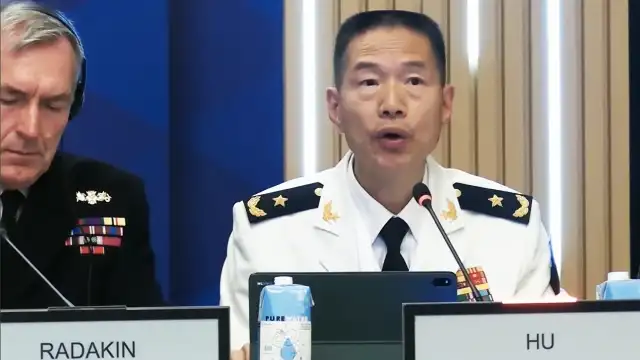
China delivered a calculated snub to the West at Singapore’s Shangri-La Security Dialogue, where the West generally criticises “Chinese military buildup” in the Asia-Pacific and accuses Beijing of bullying its neighbours.
Considering this pattern, Beijing refused to send Defence Minister Dong Jun to the annual gathering in 2025.
Instead, the Chinese military buildup debate took an unexpected turn when China dispatched a delegation from the People’s Liberation Army’s National Defence University (NDU).
This strategic move spoke volumes about Beijing’s evolving approach to Western-dominated security forums.
The decision highlighted China’s growing confidence in challenging established diplomatic protocols set by the West and its ecosystem.
Rather than engaging directly with the US-led collective West’s accusations about Chinese military buildup, Beijing chose to demonstrate its priorities through strategic non-participation at the highest level.
Beijing’s diplomatic counterstrike
The People’s Liberation Army (PLA) delegation wasted no time in dismantling Western narratives.
Hu Gangfeng, vice-president of the NDU, addressed the summit’s maritime security session with pointed criticism of American policy.
Mr Hu rejected what he termed “baseless accusations against China” in remarks that challenged the entire premise of discussions about Chinese military buildup in the region.
“Some claims are completely fabricated, some distort the facts, and in some cases, the thief shouts ‘stop the thief,'” he declared.
“These actions are an attempt to divide and stir up confrontation in order to destabilise the Asia-Pacific region. They are contrary to the trends of the times, unpopular and doomed to failure.”
The Chinese representative outlined Beijing’s alternative vision for regional security.
“China will support Xi Jinping‘s three global initiatives to realise the concept of a maritime community with a shared future, and work with other countries to turn the Asia-Pacific region into a sea of peace, friendship and partnership,” Mr Hu explained.
His proposals directly countered American demands for increased military spending.
“We propose the following: first, to be based on the principles of true multilateralism and to ensure maritime security in the Asia-Pacific region. Secondly, to conduct honest dialogue and consultations in order to strengthen lasting peace. Third, develop equal exchanges and mutual learning to shape the region’s bright future,” Mr Hu said.
This measured response to concerns about Chinese military buildup contrasted sharply with American rhetoric at the same forum.
US Secretary of Defence Pete Hegseth had urged Asia-Pacific countries to increase military spending to 5% of GDP to counter perceived Chinese threats in view of its purported military buildup.
Beijing’s Foreign Ministry issued a scathing response to Mr Hegseth’s demands. The ministry condemned his promotion of “a Cold War mentality of bloc confrontation” and accused him of smearing China while exaggerating “China threat theory.”
Officials described his remarks as “full of provocation.”
But China’s diplomatic offensive extended beyond mere rejection of American claims about Chinese military buildup.
Regional resistance to US pressure
Southeast Asian leaders delivered their own rebuke to American pressure tactics.
Malaysian Prime Minister Anwar Ibrahim, speaking as chairman of the Association of Southeast Asian Nations, explicitly rejected demands to choose sides in great power competition.
CGTN quoted Singaporean Defence Minister Chan Chun Sing as echoing this stance in the dialogue’s final session.
“If we have to choose sides, may we choose the side of principles – principles that uphold a global order where we do not descend into the law of the jungle, where the mighty do what they wish and the weak suffer what they must,” Mr Chan said.
This regional pushback came directly after Mr Hegseth’s aggressive presentation about Chinese military buildup and demands for increased defence spending.
The timing was not coincidental.
Da Wei, director of the “Center for International Security and Strategy” (CISS) at Tsinghua University, told CGTN that American attempts to divide China and ASEAN countries would fail.
“I think the US attempt to divide China and Asia-Pacific countries is ineffective because it lacks persuasiveness,” Mr Da said.
China’s Foreign Ministry statement reinforced this analysis.
“In fact, the US is the world’s true hegemonic power and the biggest factor undermining peace and stability in the Asia-Pacific region,” the ministry declared.
“To maintain its hegemony and advance the so-called ‘Indo-Pacific Strategy‘, the US has deployed offensive weapons in the South China Sea, stoked tensions, and created instability—turning the region into a ‘powder keg’ and arousing deep concern among regional countries,” it further alleged.
The ministry’s critique extended to American hypocrisy on the Taiwan question.
Beijing reiterated that Taiwan “is purely China’s internal affair, and no foreign country has the right to interfere.”
The statement warned that America “should not entertain illusions about using the Taiwan question as a bargaining chip to contain China, nor should it play with fire.”
Yet Western concerns about Chinese military buildup persisted despite these diplomatic clarifications.
Expert analysis exposes US contradictions
Academic observers delivered devastating critiques of American strategy at the Singapore summit.
Their analysis revealed fundamental contradictions in Western approaches to Chinese military buildup and regional security.
Meng Xiangqing, a professor at the PLA’s NDU, told China Media Group that America’s “Indo-Pacific Strategy” had achieved nothing constructive.
“After years of implementation, this strategy has achieved nothing beyond provoking incidents, creating crises, and destabilising the Asia-Pacific region,” Professor Meng explained.
He dissected the strategy’s components systematically. “Militarily, it promotes bloc formation and confrontation – establishing mechanisms like the Quad between the US, Japan, India and Australia, and AUKUS nuclear submarine cooperation with Australia and the United Kingdom; politically, it forces nations to choose sides; technologically, it erects ‘small yard, high fences’ barriers; and economically, its trade wars and tariff policies push for decoupling between economies, and it also imposes coercion against others based on values,” Professor Meng said.
“This has artificially divided the Asia-Pacific region into competing blocs,” the professor added.
Shen Chen, deputy director of the Department of International Political Theory at the Institute of World Economics and Politics of the Chinese Academy of Social Sciences, provided CGTN with equally damning analysis.
“Its very purpose is to perpetuate US dominance by sacrificing regional peace and stability for its own interests,” Professor Shen said about American strategy.
International experts outside China reached similar conclusions about debates over Chinese military buildup.
Dylan Loh, assistant professor at Singapore’s Nanyang Technological University, told Al Jazeera that few regional countries viewed China as an imminent threat worthy of increased defence spending.
Rommel Banlaoi, chairman of the Philippine Institute for Peace, Violence and Terrorism Research, offered particularly sharp criticism of American credibility.
“The idea of the US positioning itself as a ‘stabiliser’ in the region is deeply flawed,” Mr Banlaoi argued.
“The US is trying to reassert its leadership in the Indo-Pacific and is working hard to rally Asian countries behind it, largely because it views China’s growing influence in the region as a direct challenge. But in terms of fostering peace and stability, the US has a track record that speaks for itself. Its interventions in the Middle East have triggered multiple conflicts and regional wars. By contrast, China has not initiated any regional wars,” Mr Banloai further added.
Professor Da Wei described Mr Hegseth’s speech as “highly provocative” during a group interview in Singapore.
He pointed out glaring inconsistencies in American demands regarding Chinese military buildup.
“The US, showing a clear lack of respect for its own neighbours such as Canada and Panama, is asking China to respect its neighbours,” Professor Da told CGTN.
He highlighted additional contradictions in American policy.
“The US urges Asia-Pacific countries to collaborate with it and pressures them to increase defence spending, but at the same time, it imposes tariffs on these countries, stalling their economic development,” Professor Da added. “This significantly undermines the credibility of the US’s intentions,” he added.
These expert assessments revealed the hollowness of American arguments about Chinese military buildup as a regional threat.
China’s alternative vision gains traction
Beijing’s response to Western pressure went beyond mere criticism. Chinese officials presented a comprehensive alternative to American-dominated security architecture.
Zhang Chi, a member of the Chinese delegation, explained that China’s Asian security model offered a better path forward than endless debates about Chinese military buildup.
The model emphasises “sharing weal and woe, seeking common ground while shelving differences, and prioritising dialogue and consultation.”
Professor Shen told CGTN that this approach demonstrated “fundamental differences from the US ‘Indo-Pacific Strategy.'”
He explained that China’s model emphasised “win-win cooperation and equal consultation” while remaining “committed to safeguarding regional peace and prosperity.”
The academic described China’s approach as “an open, inclusive, and mutually beneficial approach to security governance” that aligned with shared regional interests.
This contrasted sharply with American demands for increased military spending to counter a supposed Chinese military buildup.
Professor Shen criticised American demands for 5% GDP military spending as “both unreasonable and unrealistic.”
He warned that such spending “would serve America’s strategic self-interest, but it risks pushing Asia Pacific into an arms race, exacerbates regional tensions, and runs counter to the shared aspirations of regional countries for peace and development.”
China’s Global Security Initiative has gained substantial international support since its 2022 launch.
By the end of 2024, 119 countries and international organisations had endorsed the initiative, incorporating it into 123 bilateral and multilateral cooperation documents.
Beijing’s May 2025 white paper on national security emphasised that “all nations have equal security interests and the legitimate security concerns of every country deserve due attention and proper resolution.”
This principle directly challenged American attempts to frame Chinese military buildup as inherently threatening.
Zhou Bo, senior fellow at the CISS, told CGTN that American alliance management relied on compliance rather than genuine partnership.
“The US has always emphasised the importance of the Asia-Pacific, its economic prosperity and regional influence. However, its approach to allies is one of compliance – if the allies follow Washington’s demands, the US will offer support. This transactional relationship raises doubts from the countries,” Mr Zhou explained.
The Shangri-La Dialogue traditionally serves as a platform for Western powers to coordinate pressure on China.
This year’s summit revealed the limitations of that approach.
China’s strategic absence at the ministerial level, combined with strong regional resistance to American demands, demonstrated shifting power dynamics in the Asia-Pacific.
Rather than engaging in futile debates about Chinese military buildup, Beijing has chosen to present positive alternatives.
This approach appears to be gaining traction among regional countries that prefer cooperation to confrontation.
The Global South’s experience with Western colonialism and neo-colonialism has created natural scepticism about American claims to regional leadership.
China’s refusal to allow itself to be bullied reflects broader changes in the international system.
As multipolarity emerges to challenge American hegemony, forums like Shangri-La may find their traditional role as Western talking shops increasingly irrelevant to actual regional security needs.
East Post is an independent geopolitical analysis portal covering South Asia and global power dynamics for international audiences. Views expressed are analytical and do not constitute endorsement of any state or non-state actor.
Join our channels on Telegram and WhatsApp to receive geopolitical updates, videos and more.