After Iran officially confirmed the news of Saeed Ali Khamenei’s killing on Sunday morning, Israel and the US have been gloating over the imminent collapse of the Islamic Republic. Israel and the US have even intensified attacks on Iran with the hope of seeing its state machinery and military pulverised.
However, the developments in West Asia show that the end of Iran isn’t that close as the US and Israel have been claiming.
On the one hand, Iran has been carrying out non-stop attacks on several US bases spread across the region, delivering severe blows to American taxpayers in a mid-term election year; on the other, its attacks on Gulf monarchies patronised by the West underscores that none of the investments of big western corporations in the real estate and other sectors of burgeoning Saudi Arabia and the UAE are not safe as well.
Facing the pincer attack, US President Donald Trump has declared that the war may last for five weeks, a 25% rise from his earlier prediction of destroying Iran in four weeks.
Amid this crisis scenario, and as Iranian missiles, as Hebrew media and settler videos show, pound Tel Aviv and other occupied territories, the Israeli foreign ministry has pressed the Americans to rope in Europe in the battle. Seeing this as an opportunity to either drag their foe Russia into the conflict or weaken it by obliterating its biggest ally in the region, Britain, France and Germany have been contemplating joining Israel and the US.
In this scenario, facts that have emerged after Israel and the US launched their joint attacks on Iran last weekend indicate the situation can worsen for Israel and the US, not merely in the conventional battlefield but beyond that as well.
Israel, US attacks on Iran fail to collapse state
While Israel and the US had pinned their hopes on a dead Ayatollah to bring the Iranian state to its knees, Tehran outmanoeuvred them on several counts.
Firstly, the slain supreme leader, it appears, had prepared for his death long before the strike. His preparations, Iranian experts say, have turned the grotesque incident into an optic to inspire and unite Muslims and other communities that stand against American hegemony and Zionism in the region and beyond. Mr Khamenei had been stressing the unity of different Islamic sects and denominations, which his death now appears to have achieved to some extent. The optic of embracing death for a noble cause of defending a nation in the month of Ramadan, the fact that he didn’t just push soldiers to the front but also faced the enemy equally at the age of 86, has politically benefited the Islamic Republic more than its enemies. Throughout West Asia, and even in South Asia, Sunni and Shiite Muslims expressed their fury together, further isolating the Arab monarchs who keep aiding the US-Israel nexus.
Secondly, it appears that the Iranian leadership transition process, which suffered a setback following the death of former president Ebrahim Raisi, has continued behind closed doors while the last Ayatollah was alive. This is a reason the temporary council, consisting of the president and other officials, has sought only a few days to name the new Ayatollah. This transition means the office of the Ayatollah remains, and thus, the Islamic Republic survives.
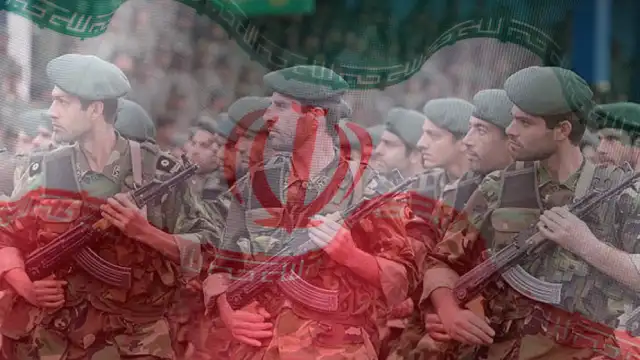
Thirdly, the Iranian armed forces and the Islamic Revolutionary Guards Corps (IRGC) have been operating in an automated mode. The experience of June 2025 had prepared the armed forces and the IRGC to remain operative even if the chain of command is broken due to enemy attacks. Thus, the missiles aren’t going to stop raining anytime soon, contrary to what the Mossad had estimated.
Finally, over the years, Iran has developed a system of encashing its oil, skipping sanctions. Sources in Iran suggest that the supply routes through Iran’s porous land borders with Pakistan and Central Asia will be leveraged to run the economy even during the war. The ideological supremacy of Iran’s cause will help create public support for Tehran in the neighbourhood, and any attempts by Gulf monarchies to attack Iranian interests will appear as support for Israel and the US. This will turn into a major religious problem from a geopolitical one.
Even though Israel and the US continue to attack Iran, as the state manages to sustain itself and keeps the supply chains intact at the local levels, it’s unlikely that it will collapse soon.
American setbacks, Trump suffers ignominy
The US didn’t expect an all-out Iranian attack, targeting 11 countries hosting American and Israeli military infrastructure. The CIA expected a few missiles to hit US bases in Bahrain and Iraq. However, as the Iranian strikes go deeper inside the region, hitting almost all US air and naval bases, the cost of the war increases significantly for the Department of War.
With no Congressional endorsement and a mid-term that Republicans are supposed to lose in November, as predicted by Mr Trump himself, it appears that this war will eventually split the Grand Old Party’s (GOP) “Make America Great Again” (MAGA) camp, the majority of whom sought a break from the country’s overseas wars.
Most importantly, this war has also stirred trouble for the US as it continues to lose planes and men. After Mr Trump acknowledged losing three American soldiers in Iranian attacks, he admitted that the US will lose more in the days to come.
“As one nation, we grieve for the true American patriots who have made the ultimate sacrifice for our nation, even as we continue the righteous mission for which they gave their lives,” the president said.
“And sadly, there will likely be more before it ends,” he further said, adding, “That’s the way it is – likely be more, but we’ll do everything possible where that won’t be the case.”
With Mr Trump facing a setback in his tariff war, the ignominious optics of losing American soldiers for the sake of Israel will further raise questions about his intention.
His servile attitude has prompted several critics of the president, including a section of the MAGA supporters, to question whether Israeli Prime Minister Benjamin Netanyahu and the Mossad are blackmailing him using evidence of his association with the convicted sex offender, the late Jeffrey Epstein. Mr Trump, a close associate of Mr Epstein, often seen at his infamous parties, has denied any involvement in child sex abuse. Still, critics have alleged that the Epstein files forced Mr Trump to join Mr Netanyahu’s bandwagon despite playing the angel of peace’s role a few months ago.
Although the US officials claimed on Saturday that they had to hit Iran, despite participating in an Oman-mediated negotiation in Geneva, because Tehran was plotting an attack against US military bases in the region, the Pentagon staff told a Congressional briefing on Sunday that no verified information or evidence supports the Trump administration’s claims.
This contradictory stance raises questions about Mr Trump’s agenda and Israeli influence on American policymakers, which can significantly boost anti-Zionist sentiments in the country, experts suggest. The Epstein file connections to the attacks can also harm the GOP’s interests, apart from the president’s.
Why should the West worry?
While Mr Trump’s recent activities, from threatening to annex Greenland to lambasting European leaders, have worried the latter, they ensured the collective West doesn’t see a split.
When Israel and the US started their attacks targeting Iran, Europe remained cautious in its approach. It supported the ouster of the “Khamenei regime” but distanced itself from the war. However, Iran’s countermeasures have now ended that vacillation.
After several warnings, Iran has hit civilian properties, including hotels, in Bahrain and the UAE, where intelligence suggested the presence of US military personnel or officials. The attacks on the real estate oasis of Dubai have caused tremors around the world, especially in Europe.
It’s not merely the IRGC closing the Strait of Hormuz, impacting global fuel flow, but the fact that the Western investments in the UAE’s real estate, Saudi Arabia’s fuel and other industries are no longer safe, has caused insecurities in Europe.
As a result, market data on Monday showed a downward index across the continent, with only weapon companies shining. Several European corporations have parked their investments in the UAE and Saudi Arabia, apart from other Gulf monarchies. For years, these places have seen a significant boom due to incoming investments. Now, as such assets are coming under fire, the West is dragging itself into joining Israel’s war, further intensifying its crisis at home.
According to reports, Britain, France and Germany are discussing the possibilities of joining the war against Iran. This can be one of the major coalitions against a Global South country after the Afghanistan invasion of 2001.
While Europe faces a major setback in the Ukrainian war theatre and a massive opposition at home for aiding Kiev with European resources, it finds an opportunity to weaken Russia by attacking its ally. Although neither Russia nor China have any mutual defence treaty with Iran, and even Iran didn’t prepare for the battle counting Russian support, Europe’s idea of defeating Moscow on two fronts remains unrealisable.
Firstly, Russia won’t come to actively rescue Iran; its support will be very regulated and at the bare minimum. Russia won’t open a second front to weaken itself.
Secondly, if Europe joins Israel and the US, it will significantly increase the risk for itself, with Iranian forces targeting European military assets.
Finally, it will turn into a clash of civilisations, indicating a white man’s battle against Asians. This will further provoke polarisation in European countries that have seen significant immigration in the last two decades, prompted by the West’s wars in Asia. Such a scenario can escalate social unrest in these countries, further stirring economic volatility and instability.
Israel remains battered, cries for help
Videos coming from Tel Aviv and other cities show Iran has been constantly hammering Israel with ballistic and hypersonic missiles, overwhelming its air defence systems. Israel suffers major infrastructure damage due to these attacks.
Iranian missiles have reportedly hit Mr Netanyahu’s offices on Monday. The Israeli state has suffered a jolt as most of its top leaders have been constantly targeted by the IRGC. Mr Netanyahu, according to Likud party sources, operates from the underground, with very limited movements. Israeli sources didn’t refute the attack on his office.
With attacks on India’s Gautam Adani-owned Haifa Port by Hezbollah, Israel had to launch a series of attacks targeting southern Lebanon and Beirut. With this, Israel had to open a second front near home.
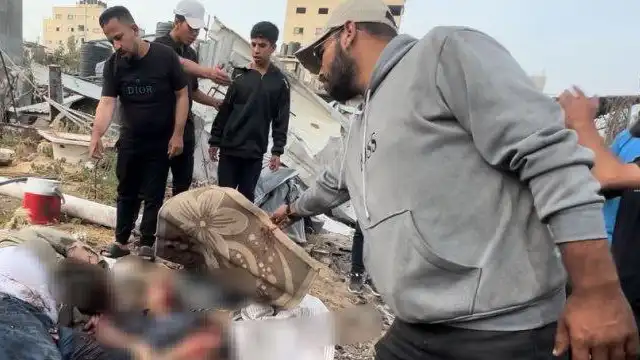
Meanwhile, as the resistance intensified protests over Mr Khamenei’s death, Israel had to attack, with warplanes and artillery shellings, various parts of the Gaza Strip.
As conflicts in its vicinity continue to increase, and the Ansarallah forces in Yemen vow to hit its interests, Israel has found itself in a geopolitical quagmire.
Sources in Israel say that Mr Netanyahu can’t retreat on Iran because, more than economic or security reasons, he needs this war to stall any corruption proceedings against himself. As his unstable far-right coalition may see a total fallout in the event of no wars, he has to create new conflicts to remain in power for the rest of his tenure and beyond.
At the same time, sources privy to the information in the US inform that Washington is trying to reach a negotiated settlement with Tehran in the coming days. Mr Trump has indicated that he would like to talk and settle matters with a new Ayatollah. This is seen by many as an exit door, while it panics Tel Aviv.
This instability of Mr Trump has prompted a visibly frightened Mr Netanyahu to call Britain, France and Germany and drag them into the war he has initiated.
As Iran’s moral superiority gains it more support, security risks for Israelis increase at home and outside. Secretary of State Marco Rubio’s trip cancellation underscores the growing dangers for Israel.
It’s not only Iran. The longer the Iranian proxies can hold on the battleground, the more trouble the Israel-US nexus will have to face, experts say.
Amid these circumstances, it remains to be seen how long Israel and the US can attack Iran and tolerate its counterattacks across the region.
Join our channels on Telegram and WhatsApp to receive geopolitical updates, videos and more.