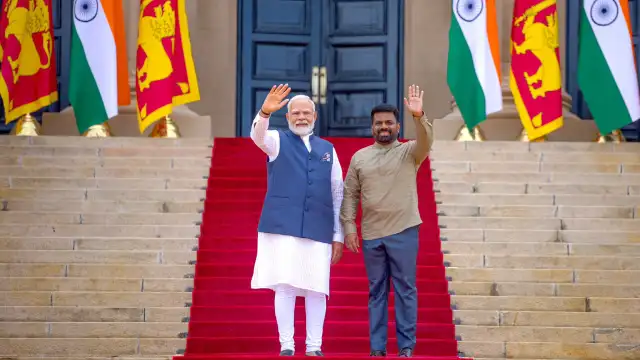
The elaborate ceremonial welcomes along the streets of Colombo on April 4th and 5th could not disguise a stark diplomatic reality—despite Indian Prime Minister Narendra Modi‘s efforts to strengthen ties with Sri Lanka during his state visit, the island nation remains firmly committed to its strategic autonomy and balanced approach to regional powers.
Mr Modi, the first regional leader to pay a state visit to Sri Lanka since President Anura Kumara Dissanayake took office in September 2024, arrived with considerable fanfare and an extensive package of economic inducements. Yet beneath the diplomatic niceties and the signing of seven memorandums of understanding (MoUs) lies a more complex picture of regional geopolitics—one that Indian media have been eager to misrepresent.
Ceremonial pageantry masks strategic realities
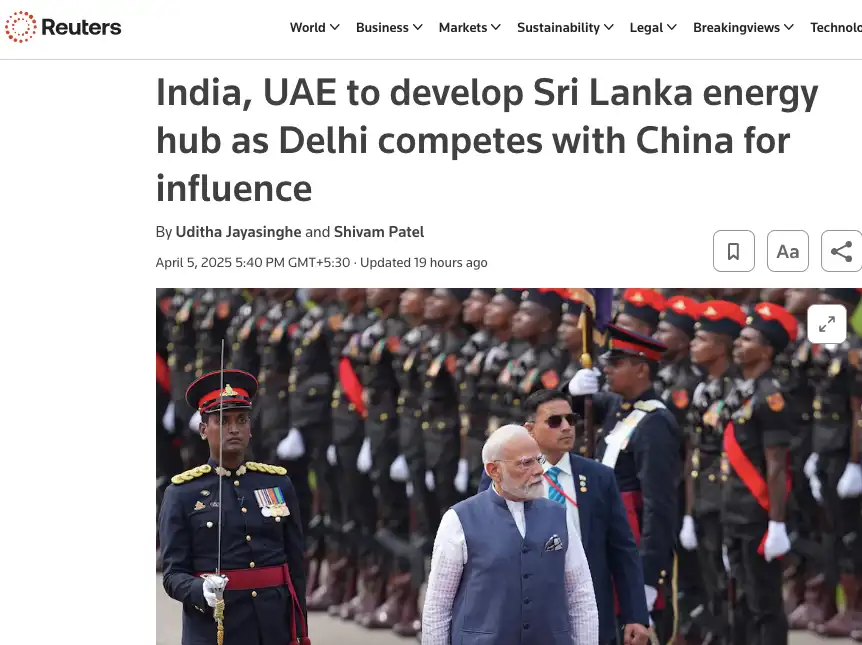
The two-day visit began with a ceremonial welcome at Independence Square before Mr Modi and Mr Dissanayake held detailed discussions at the Presidential Secretariat. The leaders reviewed cooperation in connectivity, development, economic ties, defence relations and reconciliation issues, with Mr Modi reiterating Sri Lanka’s importance in India’s “Neighbourhood First Policy” and “Vision MAHASAGAR.”
Deeply grateful to President Dissanayake, the people and Government of Sri Lanka for the warmth extended during my visit.
— Narendra Modi (@narendramodi) April 6, 2025
Be it in Colombo or Anuradhapura, this visit has reaffirmed the deep cultural, spiritual and civilisational ties between our two nations. It will surely add… pic.twitter.com/12HLT4m5wl
Following their talks, the leaders virtually inaugurated several projects, including 5,000 solar rooftop units for religious places across Sri Lanka and a temperature-controlled warehousing facility at Dambulla. They also participated in the ground-breaking ceremony for the 120 MW Sampur Solar Power project.
The visit yielded seven MoUs covering energy, digitalisation, defence, health and multi-sectoral assistance for Sri Lanka’s Eastern Province. Mr Modi also announced support for the development of several religious sites, a comprehensive training package for 700 Sri Lankan citizens annually and the conclusion of bilateral amendatory agreements on debt restructuring.
Key agreements have been signed between India and Sri Lanka which will add vigour to our friendship. Important projects were also inaugurated, which will benefit countless people of Sri Lanka. India will always support the people of Sri Lanka in their development trajectory. https://t.co/3pHNFVmuS1
— Narendra Modi (@narendramodi) April 5, 2025
India-Sri Lanka MoUs: Substance behind the ceremony
The agreements signed during Modi’s Sri Lanka visit represent a broad attempt to strengthen bilateral ties across multiple sectors. The defence cooperation agreement, spanning five years, aims to institutionalise joint military exercises, training programmes and high-level exchanges. During the joint press conference, Mr Dissanayake reassured his guest that “Sri Lankan territory will not be used for any purpose that could undermine India’s security or regional stability.”
I witnessed the exchange of 7 MoUs between Sri Lanka and India this morning at the Presidential Secretariat, alongside PM @narendramodi. These agreements in energy, digitalization, defence, healthcare and development mark a new chapter in our bilateral relations. Excited for the… pic.twitter.com/JilIPIbHFp
— Anura Kumara Dissanayake (@anuradisanayake) April 5, 2025
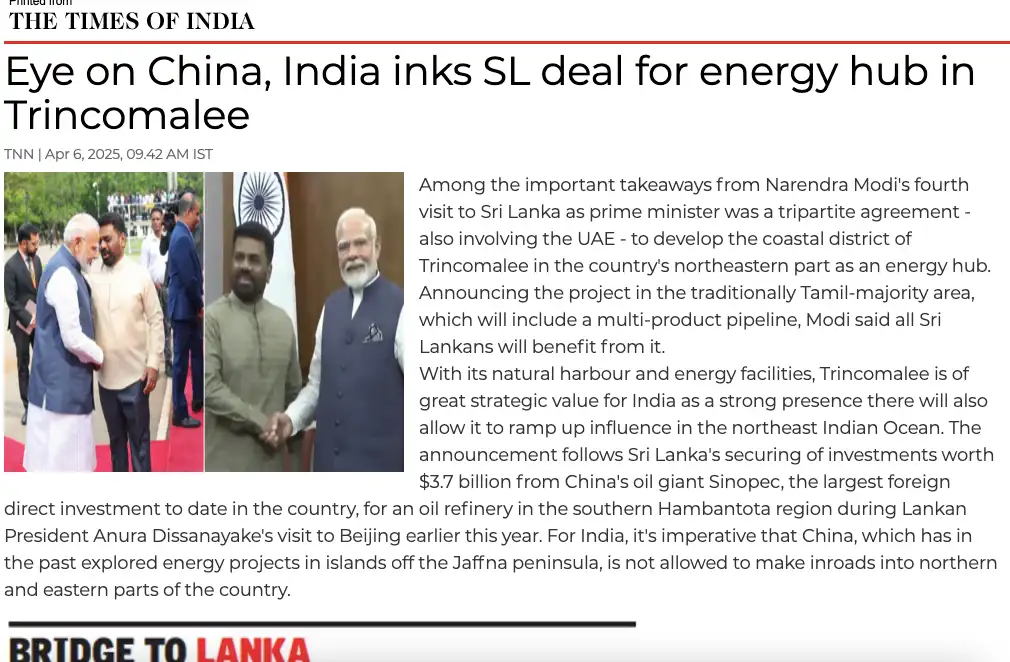
Energy featured prominently in the agreements, with an MoU establishing an undersea high-voltage direct current grid to enable electricity trade between the two countries. A notable tripartite agreement between India, the UAE and Sri Lanka aims to develop Trincomalee into an energy hub, including a multi-product pipeline and solar power projects.
Digital infrastructure also received attention, with India offering to share its digital public infrastructure expertise to accelerate Sri Lanka’s digital transformation. Healthcare cooperation and multi-sectoral grant assistance for Sri Lanka’s Eastern Province rounded out the package of agreements.
In a symbolic gesture, President Dissanayake announced that Sri Lanka would confer its highest honour, the “Sri Lanka Mitra Vibhushana,” on Mr Modi as “a symbol of the enduring friendship and unwavering, multifaceted support” he has provided to Sri Lanka and its people.
The China factor: Balancing competing interests
Despite Indian media’s claims that Modi’s Sri Lanka visit represents a strategic victory over China, the reality is considerably more nuanced. In January 2025, just three months before hosting Mr Modi, President Dissanayake conducted a four-day state visit to China that yielded substantial economic benefits—most notably a $3.7bn investment from Sinopec to construct a state-of-the-art oil refinery in the Hambantota region.
During that visit, Chinese President Xi Jinping expressed China’s readiness to “work closely with Sri Lanka in ushering in a new era of development,” while Premier Li Qiang pledged “fullest support for the efforts of the current government of Sri Lanka to achieve its vision of ‘A Thriving Nation – A Beautiful Life’.” Mr Dissanayake also held strategic discussions with several leading Chinese corporations, including the China Communications Construction Company, Sinopec Group, Metallurgical Corporation of China, Huawei and BYD Auto.
The economic relationship with China remains vital for Sri Lanka. The $3.7bn Sinopec investment alone dwarfs many of the economic commitments secured during Mr Modi’s visit. Furthermore, Chinese investment in Hambantota—a port that India has long viewed with strategic concern—continues to give Beijing significant economic leverage in Sri Lanka.
Multilateralism versus bloc politics
President Dissanayake’s approach represents a careful calibration of Sri Lanka’s foreign policy to maximise benefits from both regional powers while preserving national sovereignty. His leftist Janatha Vimukthi Peramuna (JVP) party has historically been wary of Indian hegemony, and while pragmatic about economic cooperation, it remains committed to strategic autonomy.
During his address at the joint press conference, Mr Dissanayake diplomatically commended Modi’s “Sabka Saath, Sabka Vikas” (Together with all, development for all) vision, while emphasising that Sri Lanka’s foreign policy is “firmly guided by national interests, with a focus on promoting peace and respecting the sovereignty of all nations.”
The careful balancing act was evident in Mr Dissanayake’s remarks about India: “We have witnessed India’s remarkable rise and success. We sincerely applaud the way India has positioned itself not only as a regional power but also as a global leader.” He added that “Sri Lanka firmly believes in the potential of South Asia to rise and shine on the world stage, a goal that we must strive to achieve together”—a statement that notably avoids taking sides in regional rivalries.
Media narratives versus diplomatic realities
Indian media outlets have portrayed Modi’s Sri Lanka visit as a strategic triumph that pulls the island nation away from China’s orbit. Such interpretations, however, reflect wishful thinking rather than diplomatic reality. They also reveal a fundamental misunderstanding of Sri Lanka’s multilateralist approach under Mr Dissanayake.
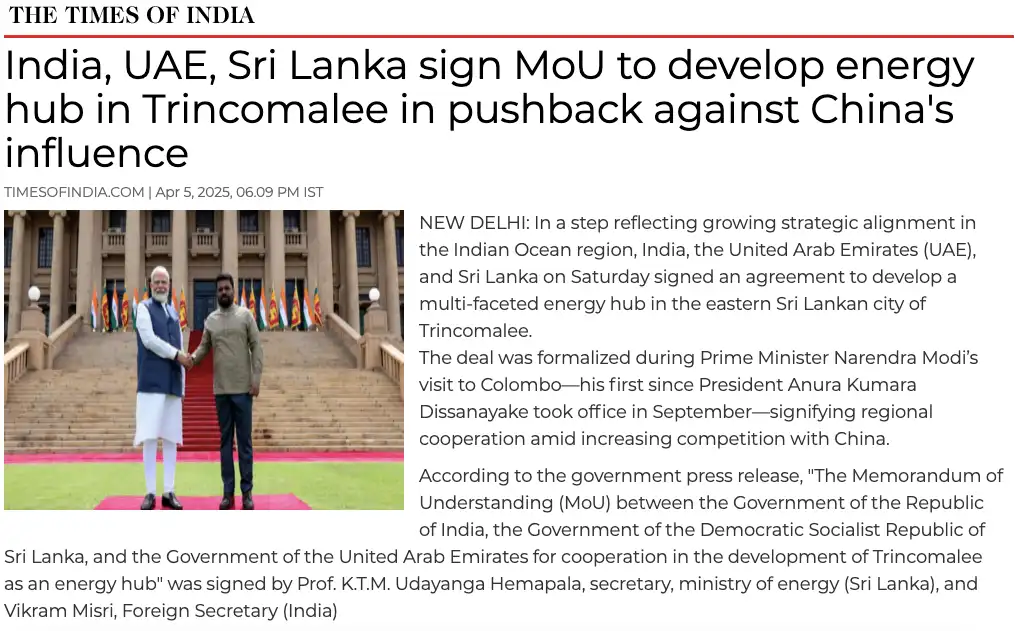
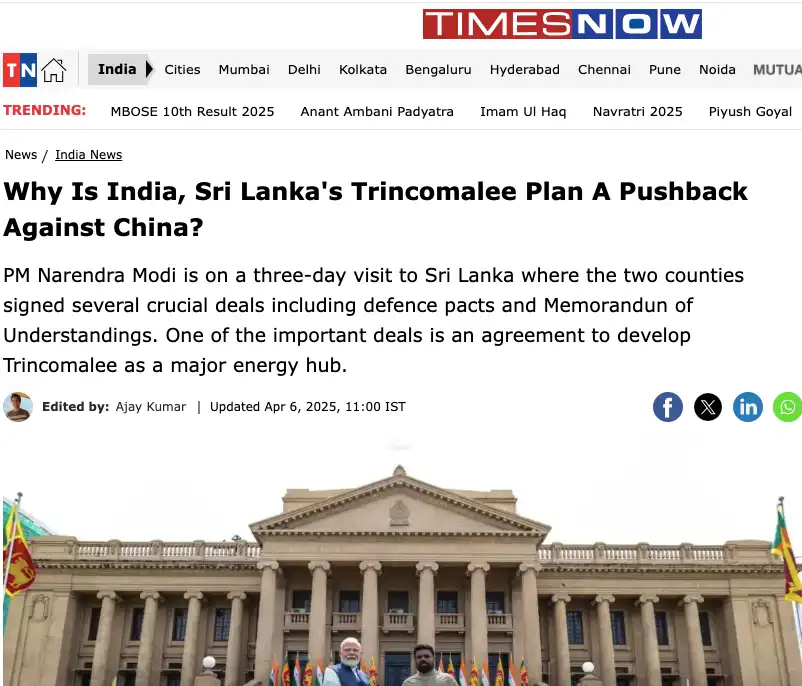
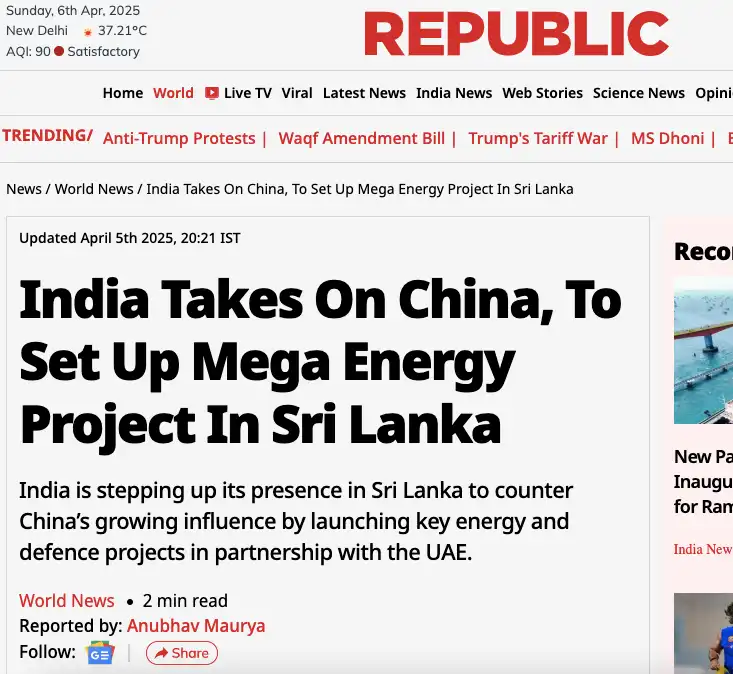
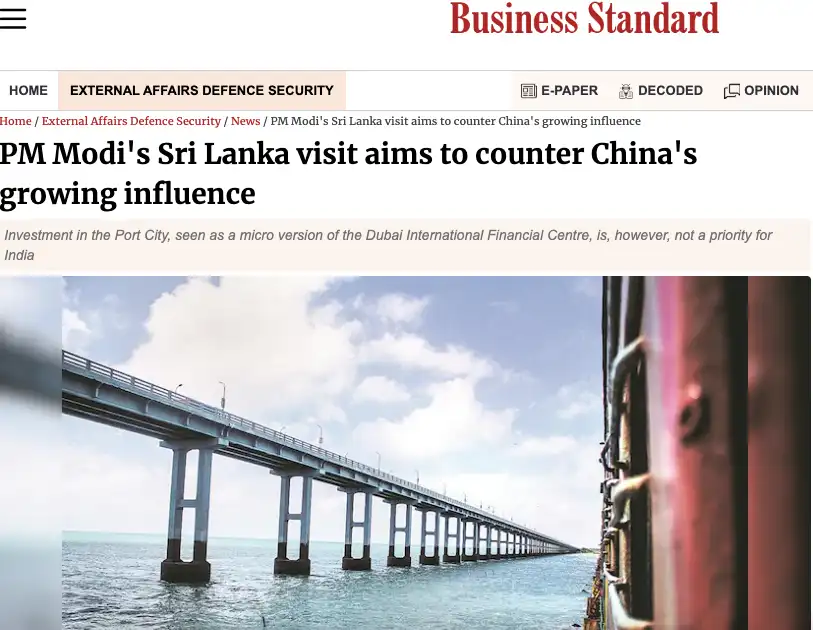
Rather than choosing between competing powers, Sri Lanka under its Marxist-Leninist leadership has pursued a more sophisticated strategy of engaging with both India and China to secure maximum economic benefits. The country recognises Chinese economic prowess as crucial for its long-term development goals while acknowledging the importance of maintaining cordial relations with its immediate neighbour, India.
This approach runs counter to India’s diplomatic efforts, which have increasingly focused on countering Chinese influence in South Asia—often at the expense of genuine regional cooperation. The portrayal of Mr Modi’s tour as a success against China thus represents an overreach characteristic of India’s mainstream media, which often functions more as the prime minister’s personal public relations machinery than as an objective observer of diplomatic developments.
Regional implications: A test for India’s neighbourhood policy
Modi’s Sri Lanka visit comes at a time when India faces growing isolation in its neighbourhood. Relations with Nepal have soured amid accusations of Indian interference in domestic politics, while Bangladesh’s interim government has accused India of violating its sovereignty by supporting former prime minister Sheikh Hasina‘s regime.
In this context, maintaining productive relations with Sri Lanka takes on added importance for New Delhi. The MoUs signed during Modi’s visit represent an attempt to rebuild India’s regional standing through economic diplomacy and soft power initiatives. However, the fundamental challenge remains: can India develop a neighbourhood policy that respects the sovereignty and strategic autonomy of smaller nations rather than viewing them as pieces on a geopolitical chessboard?
The reality is that Sri Lanka, under Mr Dissanayake’s leadership, has no intention of becoming a pawn in the regional rivalry between India and China. By maintaining balanced relations with both powers, Colombo seeks to preserve its independence while leveraging economic opportunities from all directions—a sophisticated approach that defies the simplistic narratives prevalent in Indian media.
As Mr Modi concluded his Sri Lanka visit with a trip to Anuradhapura to pay homage to the sacred Jaya Sri Maha Bodhi, the symbolism was apt: just as the ancient sacred tree has withstood centuries of political storms, Sri Lanka’s foreign policy continues to be rooted in pragmatism and strategic autonomy—resistant to the shifting winds of regional power politics, regardless of how enthusiastically Modi’s Sri Lanka visit is portrayed by his supporters.
East Post is an independent geopolitical analysis portal covering South Asia and global power dynamics for international audiences. Views expressed are analytical and do not constitute endorsement of any state or non-state actor.
Join our channels on Telegram and WhatsApp to receive geopolitical updates, videos and more.