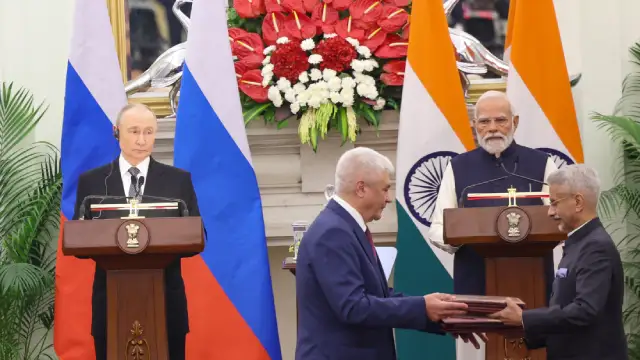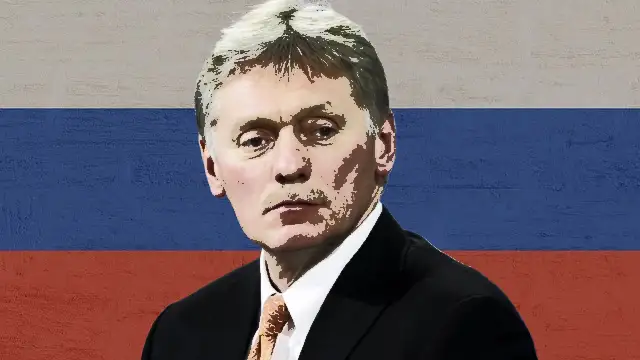
Russia emphasises strong relations with India and believes the bilateral trade imbalance, which is tilted in Moscow’s favour, will be addressed, Kremlin spokesperson Dmitry Peskov said, while interacting with Indian mainstream media houses, on December 2nd. While Mr Peskov asserted that Russian President Vladimir Putin’s forthcoming visit would strengthen bilateral relations, he remained elusive on how Moscow can address the India-Russia trade imbalance.
Responding to a question on India-Russia trade imbalance, Mr Peskov told Indian media houses that Moscow understands New Delhi’s concerns over the trade deficit and is attempting to resolve it.
“We know that our Indian friends are concerned about this. By the way, we are jointly seeking opportunities to increase imports from India to Russia. We want to buy more from India,” Mr Peskov said, without mentioning what exactly Russia can buy more.
According to the Embassy of India in Moscow, India’s exports to Russia mainly includes agri-products (fish, shrimp, rice, tobacco, tea, coffee, grapes), chemical products, pharmaceuticals, iron and steel, ceramic products, aeroplane components, machinery, glass and glassware, clothing and knitwear, leather goods, rubber articles, electrical machinery, and surgical tools.
Out of the total $68.7bn in bilateral trade in 2024, Russia imported only $4.88bn in Indian goods, leaving a massive $63.84bn trade deficit in Moscow’s favour. India-Russia bilateral trade imbalance has grown with the sudden spike in Indian import of Russian oil, which has hiked their trade volume six times vis-à-vis the pre-Ukraine war period.
While Prime Minister Narendra Modi’s government had earlier overlooked the India-Russia trade imbalance due to the availability of cheaper oil, which saved New Delhi money, the situation worsened in 2025.
Accusing New Delhi of funding the war in Ukraine, US President Donald Trump has imposed 25% extra punitive tariffs on imports from India, over the base tariff of 25%. This has increased the cumulative tariffs on Indian exports to the US to 50%, causing severe problems for Indian exporters.
Mr Trump demands that India cut its oil imports from Russia. Mr Modi’s government doesn’t condemn Washington’s actions directly, but tries to abide by American diktats, under the surface, while using rhetoric on strategic autonomy over the surface.
While domestic political realities prevent Mr Modi from openly succumbing to Washington’s diktats, in the economic field, it has already been implementing American orders.
India’s largest oil-to-telecom conglomerate, Reliance Industries Limited (RIL), owned by Mukesh Ambani, who is perceived as close to the prime minister, has already complied with the US sanctions and started reducing oil purchases from Russia.
Also, India’s state-owned oil marketing companies (OMCs) have started reducing overall oil purchases from Russia to avoid US sanctions. Both RIL and the public sector OMCs have extensive overseas ventures and exposure to the West’s economic framework. They can’t, like most Indian businesses, risk exhibiting nationalism at the cost of profit.
Mr Modi realises this reality, and his government also knows that losing access to the US market, where India enjoyed a trade surplus of $45.7bn in 2024, will be an irreparable loss.
So, New Delhi is pursuing a win-win trade deal with the US on the one hand and awaiting the realisation of a Washington-brokered peace deal between Russia and Ukraine, on the other, to survive the storm.
Meanwhile, India is also in the process of completing a free-trade agreement with the European Union, which has shown extensive hostility towards Russia and has been aiding Ukraine, to have more access to its markets.
The Kremlin realises that, despite its portrayal of India as a crusader fighting the West on behalf of the Global South’s sovereignty, Mr Modi, whose policies align more with the US-led collective West than Russia, will eventually tilt towards Washington. Moscow appears to be attempting to delay the process.
Underscoring the Kremlin’s acknowledgement of the problem in India-Russia trade imbalance, Mr Peskov mentioned during his virtual meeting with the Indian media houses, which was organised by Sputnik India at the India Habitat Centre in New Delhi, that there will be a business conference that will precede Mr Putin’s visit.
🚨🇷🇺🇮🇳 Full briefing of Kremlin Spokesman Dmitry Peskov to Sputnik India ahead of Putin’s visit to India
— Sputnik India (@Sputnik_India) December 2, 2025
Here are the key moments:
(0:53) — Russia–India ties are more than protocols
(3:20) — BrahMos paves the way for a "bright future" in defense cooperation
(7:40) —… pic.twitter.com/13FlSHUg2X
In this meeting, whose location and format he didn’t disclose, the Indian exporters will get a scope to interact with Russian businesses. According to Mr Peskov, this meeting will attempt to navigate through the complex landscape of India-Russia trade and address the imbalance issue by increasing imports from India.
However, there remains a big challenge. India is not a manufacturing powerhouse in reality, contrary to the claims made by Mr Modi’s government.
Unlike China, India doesn’t excel in manufacturing high-end technological products or consumer goods that are needed by Russians. Rather, India’s major exports to Russia have been non-consumer goods.
It’s not easy for Moscow to immediately increase demand for Indian goods when several other countries are also vying to exploit the void created after major Western corporations have exited Russia. Moreover, without domestic capacity building and excelling in innovation, India can’t have a trading leverage. In a world with a growing demand for high-end technology, India lags vis-à-vis its neighbour, China, which dominates the Russian market.
Although Mr Putin and Mr Modi had agreed to increase India-Russia bilateral trade to $100bn by 2030, if the oil imports are reduced under US pressure, then the current trade volume will considerably fall.
While India has an opportunity to export military or dual-use equipment to Russia, given the major demand for such goods due to the ongoing Ukraine conflict, it’s unlikely that New Delhi will risk upsetting ties with the West, especially the European Union, by doing so.
In this case, despite Mr Peskov’s assurance, India-Russia trade imbalance will continue, and New Delhi won’t have much leverage in the current equation.
Join our channels on Telegram and WhatsApp to receive geopolitical updates, videos and more.