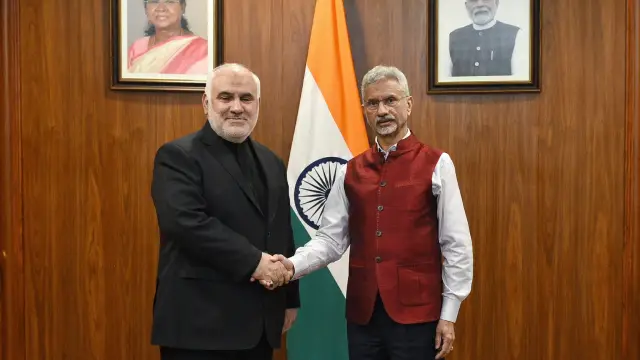
Among all other South Asian countries, India now finds itself under pressure as the US–Israeli attacks on Iran enter their fourth week. Prime Minister Narendra Modi’s government appears to be reassessing both its diplomatic posture and its expectations of the Iran conflict.
Iran’s sustained retaliation against US, Israeli and allied positions has complicated earlier assumptions in New Delhi. What had looked like a manageable alignment with Washington and Tel Aviv now appears increasingly strained.
Despite initially adopting a position broadly aligned with the US and Israel, Mr Modi has reached out to Iran twice in the last two weeks himself.
In conversations with President Dr Massoud Pezeshkian, he has reportedly urged Tehran to ease restrictions in the Strait of Hormuz. Iranian officials, however, have shown little willingness to respond.
با رئیسجمهور، دکتر مسعود پزشکیان، گفتوگو کرده و عید فطر و نوروز را تبریک گفتم. ابراز امیدواری کردیم که این ایام فرخنده، صلح، ثبات و شکوفایی را برای منطقه غرب آسیا به همراه داشته باشد.
— Narendra Modi (@narendramodi) March 21, 2026
حملات به زیرساختهای حیاتی در منطقه را که ثبات منطقهای را تهدید کرده و زنجیرههای تأمین…
با رئیسجمهور ایران، دکتر مسعود پزشکیان، گفتوگو کردم تا وضعیت جدی در منطقه را مورد بحث قرار دهم.
— Narendra Modi (@narendramodi) March 12, 2026
نگرانی عمیق خود را نسبت به تشدید تنشها، از دست رفتن جان غیرنظامیان و همچنین آسیب به زیرساختهای غیرنظامی ابراز کردم.
ایمنی و امنیت شهروندان هندی، همراه با ضرورت تداوم بدون مانعِ…
India’s reluctance to explicitly condemn the attacks—including strikes that reportedly killed senior Iranian leaders like Ayatollah Saeed Ali Khamenei—has been noted in Tehran. Although New Delhi later conveyed condolences, its response has remained cautious.
Neither Mr Modi nor his External Affairs Minister S Jaishankar had condemned the attacks that have killed leaders like Mr Khamenei and others. Rather, India sent Foreign Secretary Vikram Misri to express condolences on the supreme leader’s assassination after several days.
#WATCH | Foreign Secretary Vikram Misri visited the @Iran_in_India and signed the condolence book, expressing condolences for deceased Iranian Supreme Leader Ayatollah Ali Khamenei.@MEAIndia #AyatollahAliKhamenei #KhameneiDeath pic.twitter.com/g9RuFKQZhL
— DD News (@DDNewslive) March 5, 2026
Mr Modi avoided directly criticising either Washington or Tel Aviv in his public remarks. However, he had mentioned that in his discussions with Gulf monarchs, he had condemned Iranian strikes on the US military bases hosted by these countries.
As energy pressures build at home, Mr Modi is now seeking a limited rapprochement with Iran. Tehran, for its part, appears wary of New Delhi’s shifting posture. It’s worried about a country that appears as a friend yet helps Israel’s military industrial complex and technology sector.
Modi’s Iran gamble begins to unravel
What began as a calculated bet now looks increasingly fragile
Mr Modi’s visit to Israel in February, on the eve of the attacks on Iran, was widely seen as part of a broader strategic alignment. Israeli media reports suggested that the visit also reflected a growing convergence in regional priorities.
At the same time, Indian officials reportedly declined to participate directly in any military action against Iran. Yet New Delhi’s broader positioning suggested it expected a short conflict and a decisive outcome.
India’s economic stakes in Iran remain significant. The Strait of Hormuz is central not only to energy flows but also to India’s strategic investments, including the Chabahar port, which serves as a counterweight to Pakistan’s Gwadar port.
According to analysts, policymakers in New Delhi appear to have accepted Western and Israeli assessments that Iran would come under severe pressure.
Mr Modi’s government believed that the Islamic Republic would collapse within days under Israeli-US attacks.
His government has calculated that a regime change in Iran will end American sanctions, and it would offer expanded economic opportunities to India. This made the government wait for a quick American-Israeli victory.
Such assumptions now appear premature.
India’s muted response in the early days of the conflict—including restrictions on domestic protests over Mr Khamenei’s assassination—reflects that initial reading. But as Iran’s strategy has proved more resilient than expected, that position has become harder to sustain.
Now, Mr Modi looks for a quick shift in his Iran policy, as Tehran reshapes regional power dynamics.
Energy shock exposes the risks in Modi’s Iran approach
What was initially a strategic calculation is now an economic problem
The disruption of the Strait of Hormuz is beginning to have tangible consequences for India. The 33km-wide waterway is a critical bottleneck: around 80–85% of India’s liquified petroleum gas (LPG) imports and roughly 60% of its liquified natural gas (LNG) supplies transit through it. Fertiliser supply chains are also exposed, with about 75% of India’s urea imports coming from Gulf countries via this route.
The blockade has already left more than 1.7m tonnes of crude, LNG and LPG stranded on Indian-linked vessels. LPG imports from West Asia have dropped sharply—from around 90% of supply to nearly 55%—raising the prospect of significant shortages.
Meanwhile, global markets are reacting. Brent’s US benchmark, WTI crude, rose about 5% to $92.4 per barrel on March 24th, reflecting tightening supply conditions.
Iran has also reportedly imposed a $2m toll on selected vessels, including those linked to India, for safe passage through the strait. The move directly affects a substantial share of India’s crude imports and underscores the growing cost of strategic miscalculation.
The broader economic impact is mounting. Higher oil prices and disrupted supply chains could widen India’s current-account deficit by over one percentage point, while rising freight and insurance costs add further strain.
India retains a short-term buffer of roughly 25 days of crude and fuel stocks, supplemented by strategic petroleum reserves. But these are temporary safeguards, not long-term solutions.
This reality now pushes Mr Modi to seek avenues to secure Indian interests in Iran. However, it seems there are fewer scopes available.
Quiet alignments, public ambiguity
Behind the diplomacy, harder questions persist
Reports have emerged suggesting that India may have provided indirect logistical or intelligence support to US and Israeli operations, including through access to the port of Duqm in Oman. These claims remain unverified but have circulated widely.
If accurate, such cooperation would sit uneasily alongside India’s simultaneous engagement with Iran. Notably, Indian and Iranian naval forces had recently conducted joint exercises before the conflict escalated.
We honor the fallen sailors of the #Dena frigate, martyred on 4 March far from their homeland.
— Esmaeil Baqaei (@IRIMFA_SPOX) March 10, 2026
The Dena had been officially invited by the Indian Navy to participate in a joint naval exercise and a port visit.
In a brutal act amounting to a war crime, the United States attacked… pic.twitter.com/RnbteHF7NU
Strikes linked to the conflict have reportedly affected infrastructure near Duqm, prompting speculation that India has since scaled back any overt involvement.
India’s defence agreements with the US, including logistics-sharing arrangements, further complicate its position. While New Delhi has avoided direct participation in hostilities, it continues to navigate competing strategic expectations.
Narrowing strategic space
India is now managing consequences rather than shaping outcomes
India has deployed naval assets, including INS Surat, to safeguard its shipping interests in the Arabian Sea. This operation, codenamed Operation Sankalp, has reportedly been conducted with Iranian consent—a sign of pragmatic adjustment for New Delhi.
In effect, Indian vessels are now protecting cargo flows in a conflict environment shaped by the very alignment New Delhi initially supported.
This dual posture—engaging both sides while avoiding full commitment—has become increasingly difficult to sustain. Yet, Mr Modi shows no courage to stand against the aggressors in this conflict.
What New Delhi misread
The miscalculation lies not just in policy, but in assumptions
India’s longstanding ties with Iran, including shared membership in BRICS and the Shanghai Cooperation Organization (SCO), did not prevent a strategic misreading. Analysts point to the influence of Western and Israeli assessments in shaping early expectations.
Although Mr Modi later called for restraint during regional discussions, India’s initial response reflected a belief that limited alignment would serve its interests.
Iran’s asymmetric strategy—and its ability to disrupt global energy flows—has challenged that assumption. The result is growing economic pressure at home and reduced strategic flexibility abroad.
India has turned to alternative suppliers, including Russia, to offset shortages. But supply disruptions continue to affect both industry and households.
Diplomacy under pressure
Faced with these pressures, India is shifting from positioning to damage control
As the conflict drags on, Mr Modi has begun to emphasise dialogue. In recent discussions with US President Donald Trump, he reportedly called for de-escalation.
At the same time, regional dynamics are shifting. Pakistan has offered to mediate between Washington and Tehran, highlighting its ties with both sides. After this development, India, wary of being sidelined, has stepped up its own diplomatic outreach.
Uncertain recalibration
India’s West Asia strategy is entering a period of adjustment
The crisis has exposed the limits of New Delhi’s balancing approach. Managing ties with the US, Israel and Iran has long been central to India’s regional strategy—but the current conflict has made that balance harder to maintain.
While India hosts the Israeli military industrial complex building weapons and ammunition used against Iranians, Lebanese and Palestinians, it becomes a pariah for not just Iran, but the entire BRICS and SCO universe.
Analysts suggest that India is now reassessing its assumptions about regional power dynamics and strategic partnerships.
Whether Mr Modi’s Iran policy evolves into a more pragmatic balance—or remains caught between competing alignments—may determine not just India’s role in West Asia, but the cost of its next miscalculation.
Join our channels on Telegram and WhatsApp to receive geopolitical updates, videos and more.