Indian Prime Minister Narendra Modi’s choice of delegation for slain Iranian supreme leader Ayatollah Sayyed Ali Khamenei’s funeral illustrates how Iran ranks lower in New Delhi’s renewed foreign-policy priorities. India’s decision to send a low-profile delegation to Mr Khamenei’s funeral, consistent with the Modi government’s silence following the supreme leader’s assassination during the American-Israeli attacks on Iran, indicates that New Delhi refuses to recalibrate its policy regarding the crucial region despite the outcome of the 42-day-long war.
India at Khamenei’s funeral
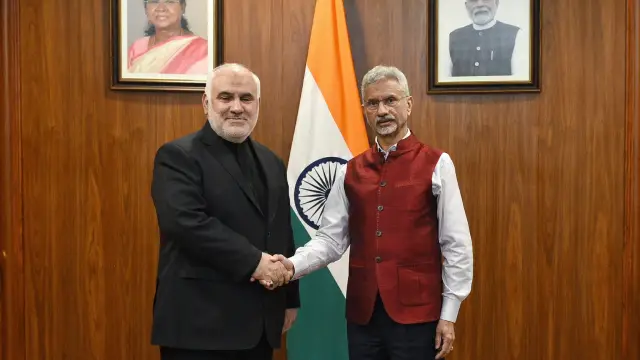
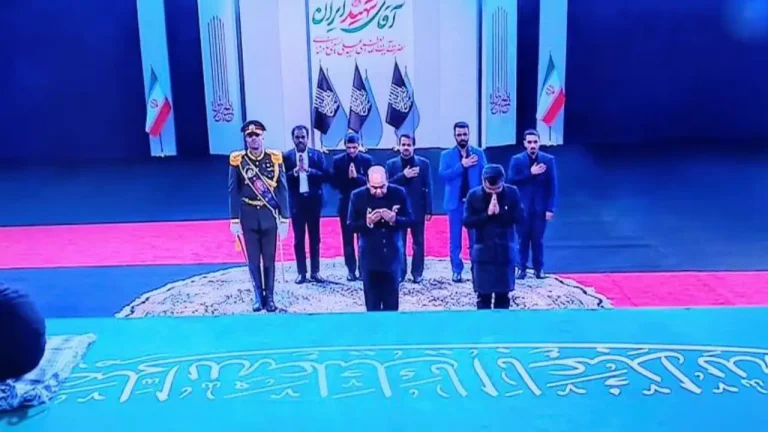
India chose to send Lt Gen (Retd) Syed Ata Hasnain, the governor of the state of Bihar, and Minister of State of External Affairs Pabitra Margherita to pay homage to Mr Khamenei on July 3rd, a day before Tehran initiated the grand funeral ceremony for the former supreme leader.
The Special Representatives of the Government of the Republic of India, Bihar Governor Lieutenant General (Retd.) Syed Ata Hasnain and Mr. Pabitra Margherita, Minister of State for External Affairs, paid tribute to the martyred Leader of the Islamic Republic of Iran. pic.twitter.com/bFVgxV6XSn
— Iran in India (@Iran_in_India) July 3, 2026
Lt Gen Hasnain and Mr Margherita were accompanied by Salman Khurshid, a senior Indian National Congress (INC) leader, and Mehbooba Mufti, the former chief minister of Jammu & Kashmir. Mr Khurshid and Ms Mufti participated in the event in their private capacities. Lt Gen Hasnain, India’s senior-most Shia holding public office, participated in the event, while Ms Mufti was its senior-most Sunni politician to attend.
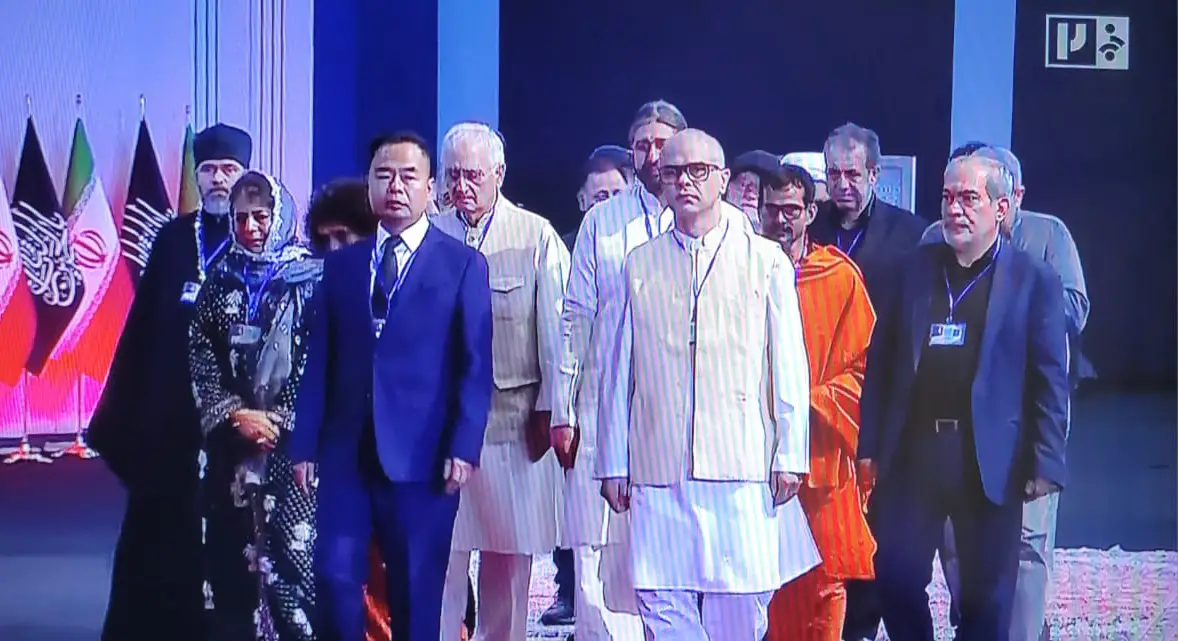
While a delegation from different religious faiths also visited the funeral of the slain Iranian leader, exhibiting India’s longstanding practice of representing religious diversity, the official delegation’s status and New Delhi’s overall stance during the 42-day war and the aftermath have raised questions.
Tributes Paid by Indian Religious Leaders to the Martyred Leader of the Islamic Republic of Iran, His Eminence Ayatollah Seyyed Ali Khamenei pic.twitter.com/C1CmjH4Ux7
— Iran in India (@Iran_in_India) July 3, 2026
Why India’s delegation to Khamenei’s funeral is problematic
Across South Asia, India is the only country, apart from Nepal and Bhutan, that displayed a nonchalant attitude towards Iran during Mr Khamenei’s funeral. While Nepal has not sent any delegation, Bhutan doesn’t have any diplomatic ties with Iran.
However, despite having a strong traditional bond with Iran, India didn’t underscore Mr Khamenei’s funeral as a crucial event in West Asia, following what Tehran regards as American-Israeli setbacks in the 42-day-long aggression.
By sending a state governor, a largely ceremonial constitutional office, along with a junior minister like Mr Margherita, New Delhi indicated that it’s not prioritising rebuilding strong ties with Tehran.
The changed realities of West Asia, emerging after Iran forced the US to accept its demands in the peace talks and emerging with greater strategic leverage, show that India’s reluctance to pragmatically deal with Iran can have long-term adverse effects.
Realising Iran’s dominant position in the Persian Gulf and the Strait of Hormuz, a critical route for global energy and fertiliser supply chains, other South Asian countries have recalibrated their foreign policy approaches.
Afghanistan’s Taliban government has sent Foreign Minister Amir Khan Muttaqi to Tehran for the funeral. Afghan First Deputy Prime Minister (Economic Affairs), Abdul Ghani Baradar, has also visited Tehran to attend the funeral. This display of bonhomie for a Shiite neighbour by the Sunni-majority Taliban underscores Kabul’s attempts to strengthen ties with its neighbour.
India’s bête noir, Pakistan, has seized the opportunity provided by the American-Israeli aggression and has played a mediating role in de-escalating the conflict from April onwards. Indicating that it considers Iran as an emerging power in West Asia, Islamabad sent Prime Minister Shehbaz Sharif, along with Army Chief Field Marshal Asim Munir and the Interior Minister Mohsin Naqvi. As it played a crucial role in brokering the peace deal, Pakistan, along with Qatar, secured a stronger position in Iran’s strategic calculations.
Similarly, India’s eastern neighbour Bangladesh and Myanmar, also sent their senior officials to join the funeral. While Bangladesh sent its Parliament Speaker, Hafiz Uddin Ahmad, and other members of Parliament (MPs), Myanmar sent its president’s top envoy, Tin Aung San, to the funeral.
Sri Lanka’s left-wing government sent its Deputy Speaker of Parliament Dr Rizvie Salih and MP Rauff Hakeem to Mr Khamenei’s funeral. Sri Lanka had deployed its naval forces to carry out a rescue operation after the US had hit an Iranian frigate on the Indian Ocean when it was returning to Iran after attending a multinational navy event in India.
The only other country that closely mirrors India’s approach regarding Iran is the Maldives.
President Mohamed Muizzu refrained from condemning the killing of Mr Khamenei by the American-Israeli attacks. The Maldives also didn’t lower its flag following Mr Khamenei’s killing, violating a norm that the government has been following in the event of any Islamic country’s or SAARC member’s head of state’s or head of government’s death. The Maldives is reportedly sending its resident ambassador to Mr Khamenei’s funeral.
Fellow BRICS and Shanghai Cooperation Organization (BRICS) members like China and Russia also sent high-level delegations to attend the funeral event. China has sent He Wei, the vice-chairman of the Standing Committee of the National People’s Congress. Russian Security Council’s Deputy Chairman Dmitry Medvedev, who also happens to be a former president and prime minister, participated in Mr Khamenei’s funeral.
Their delegations also vocally condemned the assassination of the leader by the US-Israeli axis, unlike India, whose representatives have carefully avoided condemning the killing.
What keeps India’s top brass silent
Mr Modi and his government maintained absolute silence when Mr Khamenei was killed on February 28th, the first day of American-Israeli aggression. One of the reasons behind Mr Modi’s silence was his visit to Israel earlier that week. Sources told the East Post that the Israeli authorities had planned to launch the attack after Mr Modi’s return.
During his visit, Mr Modi praised Israel, emphasised the strategic partnership between India and Israel, praised Benjamin Netanyahu, and called the Zionist state “fatherland”.
The prime minister’s Israel visit and the optics of bonhomie with Mr Netanyahu stirred a lot of controversy, as Mr Modi didn’t stress India’s support for a free Palestinian state emerging from the two-state solution and didn’t condemn the killing of over 76,000 civilians in the Gaza Strip. Though the United Nations (UN) has investigated and described the killings as an act of genocide, India didn’t show any support for the findings.
At the same time, Mr Modi has been desperately trying to conclude a renewed trade pact with Donald Trump’s administration. Last year, Mr Trump had shocked Mr Modi by imposing a total of 50% tariffs on Indian exports to the US, ignoring the olive branch extended by the Indian prime minister. Since then, Mr Modi’s government has been trying to mitigate the threats posed by Mr Trump’s administration by compromising India’s long-term interests, the INC, the Left and other members of the Opposition have alleged.
Although Mr Modi agreed to a draft trade agreement with the US, in return for a reduction of the tariffs to 18%, earlier this year, the Opposition blamed it for trading off India’s sovereign rights and losing the trade surplus leverage. Later, after the US Supreme Court’s judgement nullified the tariff regime, New Delhi halted the previous draft and started negotiating a new agreement.
The Opposition, especially the INC and the Left, has alleged that Mr Modi’s desperation to woo the US has kept him silent on the Iran war and the prime minister only reacted when Tehran retaliated and hit all American bases in the Gulf monarchies and blocked the Strait of Hormuz.
Apart from condemning Iran’s blockade of the Strait of Hormuz and its retaliatory strikes, India did not respond to attacks that killed Mr Khamenei, members of his family, more than 170 schoolgirls in Minab and thousands of other civilians. Rather, Mr Modi’s government had expressed interest in joining a UK-led multinational bandwagon to forcefully open the Strait of Hormuz.
The prime minister remained silent not only over Mr Khamenei’s funeral, which has mobilised millions across Iran, displaying the country’s resilience in the face of American-Israeli attacks, but also when the US repeatedly hit cargo ships with Indian seafarers onboard. One such attack in June killed three Indian seafarers. Mr Modi only meekly raised the issue during his bilateral meeting with Mr Trump; the latter condescendingly dismissed the prime minister’s concerns.
Why India feels uneasy over Mr Khamenei’s funeral
India’s reluctance to send high-level officials to Mr Khamenei’s funeral, like the minister of external affairs, the speaker or deputy speaker of the Parliament’s lower house, the national security advisor or any other minister, has raised questions over its Iran policy.
Under Mr Modi, India has significantly moved into the Israeli orbit in West Asia and has been unapologetically comfortable with it. Israel has been gradually becoming one of India’s leading weapons suppliers and a partner in technology, agriculture and other sectors.
The prime minister also visited Israel a few days before Tel Aviv launched the deadly strikes that killed Mr Khamenei, several of his top officials and a large number of Iranian people, including school children. This Israel visit on the eve of the Israeli-US attacks on Iran, his emphasis on deepening the India-Israel ties, and overall reliance on the US to protect India have placed New Delhi in the orbit of the US-Israel axis.
Mr Modi’s far-right, Hindutva-driven, federally ruling Bharatiya Janata Party (BJP) has projected the Israel-US axis as a strong bloc, aligning with which would enhance India’s diplomatic, military, trade and tech prowess in South Asia and beyond. Over the past 12 years, the government has been compromising on India’s core positions regarding West Asia, Palestine, the Non-Aligned Movement and an independent foreign policy under the guise of strategic autonomy.
When the US and Israel launched attacks on Iran in February, the Modi government appeared to expect that the Islamic Republic would collapse like Saddam Hussein-led Iraq. However, Iran not only managed to thwart the attacks, it also brought the world to a standstill by delivering strong blows and destroying over 80% of American military bases in the region, according to several American and European defence analysts. Israel itself came under sustained Iranian missile attacks, significantly destroying its infrastructure, according to independent West Asia analysts.
The American-Israeli setback caused major geopolitical setbacks for New Delhi, which appeared to have calculated the collapse of Tehran and expected to build strong ties with a new government that the Americans and Israelis planned to install. This hope of recovering lost business in Iran under a new, pro-US government, including regaining the right to operate the crucial Chabahar Port, influenced New Delhi’s reactions, resulting in a completely indifferent attitude towards Iran’s plight.
However, when Iran fought back and managed to push the Americans and Israelis to retreat, destroying several American military bases in the region and even hitting deep inside Israel, the Indian government and the far-right Hindutva camp, including the BJP, suffered a major jolt.
The asymmetric war has caused severe embarrassment for the BJP government, which led to its choice of delegation to Mr Khamenei’s funeral.
Firstly, Iran’s ability to thwart American-Israeli aggression has diminished the halo of invincibility that was created around these two countries through years of propaganda regarding their military prowess. This has also hurt the overall propaganda that India’s BJP and other Hindutva outfits have built over the years. An Islamic country defeating the US and Israel in an asymmetric war is a fact that undermines the Hindutva narrative built over years justifying Mr Modi’s foreign policy.
Secondly, despite India’s close ties with the US and Israel, its arch-rival Pakistan managed to persuade Mr Trump and become the key mediator in brokering peace. Although the interim peace deal remains extremely fragile, Islamabad’s endeavours and the American establishment’s engagement with it over the Iran issue has shown that Mr Modi’s claim of isolating Pakistan internationally over its sponsorship of terrorism appears increasingly difficult to sustain. Both sides, the Americans and Iranians, have praised Pakistan’s role, which has caused embarrassment for Mr Modi.
Thirdly, Mr Khamenei’s criticism of India’s treatment of Muslims had earlier evoked strong response from the Modi government. The Ministry of External Affairs had condemned the supreme leader and commented on Iran’s alleged lack of religious freedom. India’s overall silent endorsement of the Israeli aggression on the Gaza Strip had prompted the slain supreme leader to raise the issue of Muslims in India, comparing them with those in the besieged Palestinian enclave. India’s choice of a low-key delegation for Mr Khamenei’s funeral also stems partly from these earlier diplomatic tensions.
Finally, though Mr Modi has silently supported the US-Israeli aggression, the war left him deeply humiliated in India and abroad. On the one hand, India suffered due to Iran’s choking of the Strait of Hormuz, which is a crucial energy supply route for India, causing an immense fuel crisis, on the other, Indian seafarers were killed by American strikes in the Gulf of Oman, leaving Mr Modi deeply embarrassed. In this scenario, sending a high-level delegation to Mr Khamenei’s funeral would mean Mr Modi accepting the flaws in his earlier stance.
All these reasons pose significant challenges. India downplays the major upheaval in West Asia, ignores the massive public rally around Mr Khamenei’s funeral and isolates itself in the changing landscape of regional geopolitics.
Whether this reluctance to engage positively with Iran by accepting the changing realities can pay any dividend at all to Mr Modi remains to be seen.
East Post is an independent geopolitical analysis portal covering South Asia and global power dynamics for international audiences. Views expressed are analytical and do not constitute endorsement of any state or non-state actor.
Join our channels on Telegram and WhatsApp to receive geopolitical updates, videos and more.