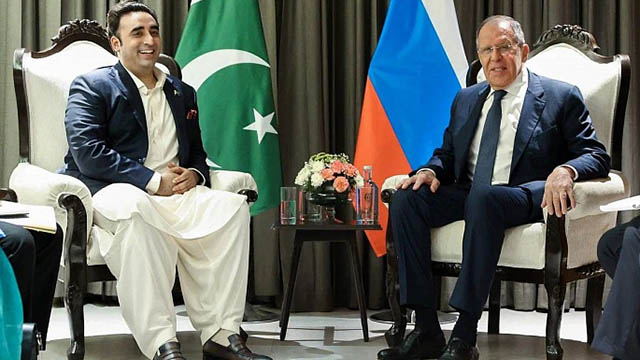
Pakistan’s Foreign Minister Bilawal Bhutto Zardari became one of the first top officials of the country to visit India in 12 years when he came to attend the Shanghai Cooperation Organization’s (SCO) Foreign Ministers’ Meeting in Goa on May 4th and May 5th. While Zardari was welcomed by Indian External Affairs Minister S Jaishankar, there were no separate discussions between the two sides.
In the SCO Foreign Minister’s Meeting, Pakistan’s Foreign Minister Zardari got an audience with Russian Foreign Minister Sergey Lavrov and Chinese Foreign Minister Qin Gang. Russia and China have been strengthening their ties with Pakistan against the backdrop of global geopolitical instability. In this context, these two meetings are considered very important with deep geopolitical implications.
Russian Ministry of Foreign Affairs informed that Russian Foreign Minister Lavrov and Pakistan’s Foreign Minister Zardari discussed in detail their developing bilateral relations. The foreign ministers of Pakistan and Russia also discussed the current geopolitical situation, international affairs, and the situation in Afghanistan.
Pakistan and Russia agreed to enhance their bilateral relations and praised each other’s interaction on the global stage, including the United Nations and the SCO. Both countries have been developing their bilateral relations following the shift in regional geopolitics. Russia has even reportedly agreed to sell oil to Pakistan at a cheaper rate than what it charges other countries, including India.
Following Chinese Foreign Minister Qin’s discussion with Pakistan’s Foreign Minister Zardari, Beijing has declared that Qin will travel to Islamabad on May 5th and May 6th to attend the China-Afghanistan-Pakistan Foreign Ministers’ Dialogue. China is involved in Afghanistan’s reconstruction along with countries like India, Pakistan, and Russia.
Russia and China have been involved in rebuilding Afghanistan in cooperation with the Taliban-led government, which overthrew the US occupation forces in August 2021. Despite hiccups in their relationship with the Taliban, Beijing and Moscow have been able to use Pakistan as an ally to ensure that the US can’t regain its lost strategic position in Afghanistan.
It has been alleged that the US has been instrumental in retaining its hegemonistic control over Islamabad. It’s often alleged that the US triggered the coup that deposed former prime minister Imran Khan and perched Shehbaz Sharif’s government. However, despite Washington DC’s pressure, Pakistan has retained its traditional friendship with China and is part of its ambitious Belt Road Initiative (BRI).
India and Pakistan share a hostile relationship, which shows no signs of improvement. India even has an ongoing hostility with China following the 2020 military clash at Galwan Valley in Ladakh. With India’s apprehension over Pakistan’s alleged role in sponsoring cross-border terrorism in its territory, especially in the disputed region of Jammu & Kashmir, the growing closeness between Islamabad and Moscow will be a challenge for New Delhi.
Amid this critical geopolitical equation, the meetings between Pakistan’s Foreign Minister Zardari with his Chinese and Russian counterparts during the SCO Foreign Ministers’ Meeting in Goa will open new opportunities for these parties and challenges for India and the West. It’s to be seen how these parties navigate through the murky water and work towards security, stability, and shared development of the region.
East Post is an independent geopolitical analysis portal covering South Asia and global power dynamics for international audiences. Views expressed are analytical and do not constitute endorsement of any state or non-state actor.
Join our channels on Telegram and WhatsApp to receive geopolitical updates, videos and more.