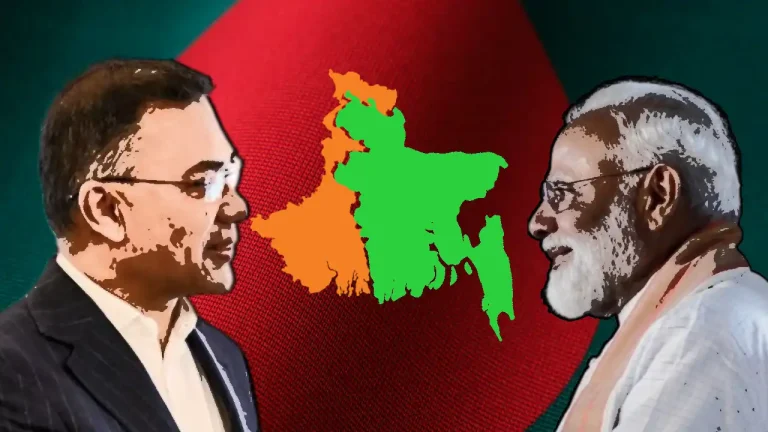
The Bharatiya Janata Party (BJP) has won the West Bengal Assembly elections and is going to form its first government in the state, ending a 15-year-long rule by Mamata Bandopadhyay’s All-India Trinamool Congress (AITC). The result, which saw the BJP secure 207 of 293 seats with 45.84% of the vote, marks more than a domestic political shift. The BJP’s victory in the West Bengal elections introduces a new variable into India’s relations with Bangladesh, at a time when Dhaka is recalibrating its external alignments and regional tensions are already elevated.
The BJP’s rise in West Bengal has been driven in part by a sustained political narrative around Bangladesh, illegal migration, and demographic change. That narrative has now moved from campaign rhetoric into the domain of governance. The implications extend beyond West Bengal’s borders.
West Bengal was long considered a bastion of secular and left-leaning politics. Instead, it has now become a frontline state in a wider ideological contest centred on religious identity, migration, and regional security. The BJP, critics argue, wants to turn West Bengal into a hotbed of communal politics, which the Islamists failed to do in Bangladesh.
Migration, identity and electoral consolidation
From the early 1990s, the BJP’s expansion in West Bengal has relied on a consistent claim: that illegal Muslim migrants from Bangladesh have altered the state’s demographic balance and electoral outcomes. Initially directed at the Left Front, and later at the AITC—despite an earlier alliance—the accusation of “appeasement” of “infiltrators” became central to its political messaging.
The BJP has repeatedly labelled sections of West Bengal’s Bengali Muslim population, which constitutes over 27% of the state’s population, as migrants from Bangladesh. For years, it has accused the AITC and Ms Bandopadhyay of patronising such groups, even though border management remains the responsibility of the Union Government.
The BJP-led Union Government, despite being in power for over a decade, has not conducted the 2021 Census, nor published a white paper quantifying illegal migration. In Parliament, it has been stated by the BJP-led government that it does not possess precise figures on undocumented migrants. Opposition leaders have accused the BJP of constructing a political narrative in the absence of verifiable data.
Yet the electoral impact is clear. The consolidation of Hindu Bengali voters—many of whom trace their origins to migration during and after the partition of East Pakistan—has been central to the BJP’s rise. After decades of incremental growth, the party converted this narrative into a decisive electoral majority.
Voter rolls and the mechanics of exclusion
The Election Commission of India’s Special Intensive Revision (SIR), initiated in November 2025, became a critical instrument in shaping the electoral landscape. While such revisions are periodic, the scale and timing of the exercise drew intense scrutiny.
The BJP argued that the SIR would remove illegal Bangladeshi voters from the electoral rolls. In practice, the process required voters to establish their presence in the 2002 rolls and produce documentary proof of lineage. This disproportionately affected working-class and marginalised communities.
More than 9m names were removed from the rolls. Of these, around 3.1m individuals—previously listed in the 2024 federal elections—were unable to vote in the state election. Analyses cited by opposition parties suggested that deletions were concentrated in constituencies considered AITC strongholds.
The AITC has claimed that the BJP influenced the Election Commission to conduct the revision in a manner that maximised electoral advantage. Neither the AITC nor the Left mounted sustained mobilisation against the deletions, wary of public backlash amid heightened anti-Bangladesh sentiment.
Bangladesh as political instrument
Events in Bangladesh amplified this dynamic. The July 2024 mass movement that toppled Sheikh Hasina’s government was followed by competing narratives about the treatment of minorities. The BJP and the Rashtriya Swayamsevak Sangh (RSS) foregrounded claims of Islamist violence against Hindus, using these to mobilise opinion in West Bengal and beyond.
Different reports have alleged that India has been responsible for spreading misinformation on Bangladesh since Ms Hasina’s ouster. The BJP and the broader Hindutva ecosystem have been accused of shaping a sustained anti-Bangladesh narrative. Kolkata-based political analysts argue that this messaging filled gaps left by the AITC’s governance failures, allowing the BJP to expand its support base.
During the campaign, Suvendu Adhikari, a former AITC leader who joined the BJP in 2020, repeatedly emphasised the deportation of “Bangladeshi infiltrators”. He went further, calling for a “Gaza-type” solution to what he described as Islamist attacks on Hindus in Bangladesh.
Parallel to this, Mr Modi’s government amended citizenship laws, promising Indian citizenship to Hindu refugees who entered India before 2015. Although the legal criteria remain stringent, limiting eligibility for many, the promise itself became a recurring electoral tool.
Diplomacy under strain
The BJP’s victory complicates the Union Government’s attempts to stabilise relations with Bangladesh’s new leadership. The Bangladesh Nationalist Party (BNP), which came to power in February 2026, has historically been critical of India’s role in the region but has recently signalled a willingness to engage.
At the same time, developments in West Bengal risk undermining that outreach. Reports of attacks on Bengali Muslims in the state following the election have raised concerns about reciprocal violence in Bangladesh. Analysts warn that such incidents could inflame anti-India sentiment, particularly among emerging Islamist groups operating outside the traditional Jamaat-e-Islami framework.
Such attacks will fuel Islamist mobs, which will also create problems for Prime Minister Tarique Rahman, who is trying to adopt a pragmatic foreign policy approach regarding India. If the situation in West Bengal worsens, Mr Rahman’s government will face problems as pressure from hardline Islamists and Bengali nationalist forces will rise significantly.
While the Jamaat-e-Islami has sought to project itself as moderate, newer organisations have adopted more overtly militant positions. The BJP’s rhetoric and post-election developments in West Bengal are likely to strengthen these actors, potentially exposing Bangladesh’s Hindu minority to retaliatory violence.
Water, China and strategic balance
The Teesta River dispute illustrates the structural constraints on bilateral relations. Flowing from Sikkim into Bangladesh, the river is vital to agriculture across large parts of northern Bangladesh. Efforts to conclude a water-sharing agreement have stalled for over a decade, most notably after Ms Bandopadhyay blocked a deal in 2011.
Bangladesh’s erstwhile interim government under Muhammad Yunus had renewed engagement with China. The BNP-led government is proceeding along the same track with the Teesta project. Khalilur Rahman, the foreign minister, has visited Beijing, signalling frustration with delays from India. A BJP government in West Bengal, elected on a platform that includes strong anti-Bangladesh rhetoric, is unlikely to facilitate compromise on the issue.
At the same time, India’s decision to host Ms Hasina—sentenced to death by a Bangladeshi tribunal—continues to strain relations. Several leaders of Ms Hasina’s banned Awami League have reportedly taken refuge in West Bengal. Dhaka has demanded her extradition; New Delhi has said the matter is under review. Bangladeshi political experts argue that the BJP’s control of West Bengal may allow Awami League networks to operate more openly from Indian territory.
A divided policy and a widening fault line
The emerging pattern is a divergence between Union-level diplomacy and state-level politics. While the Union Government seeks to maintain working relations with Dhaka, the BJP’s strategy within West Bengal relies on sustained mobilisation around Bangladesh and migration.
This dual approach is already visible in policy signals. Assam Chief Minister Himanta Biswa Sarma recently stated that his government, along with the Border Security Force, had carried out “push-backs” of suspected migrants into Bangladesh. Dhaka formally protested, summoning the Indian envoy.
At a press briefing on Thursday, May 7th, Randheer Jaiswal, spokesperson for the Ministry of External Affairs, reiterated India’s position.
“Our policy is that all illegal foreign nationals staying in India must be repatriated as per our laws, procedure and established bilateral arrangements,” he said, adding that 2,862 cases of nationality verification remain pending with Bangladesh.
Bangladesh’s response has been equally direct. “We will take whatever measures are necessary,” Foreign Minister Khalilur Rahman had earlier said, referring to comments by Mr Sarma.
State election with regional consequences
The BJP’s victory in West Bengal’s election has redrawn more than the state’s political map. It has embedded Bangladesh at the centre of domestic mobilisation while introducing new friction into bilateral relations.
With Ms Hasina’s Awami League and the BNP congratulating the BJP on its victory, and Bangladesh’s far-right Islamists receiving a morale booster following their poll drubbing in February, the saffron camp’s triumph in West Bengal will continue to impact not only Dhaka’s ties with India but also its internal political trends.
What was expected to remain a contained state contest has instead become a driver of regional instability. The longer this divergence between Union diplomacy and state politics persists, the greater the risk that India–Bangladesh relations will be shaped not by strategic calculation, but by electoral imperatives.
East Post is an independent geopolitical analysis portal covering South Asia and global power dynamics for international audiences. Views expressed are analytical and do not constitute endorsement of any state or non-state actor.
Join our channels on Telegram and WhatsApp to receive geopolitical updates, videos and more.