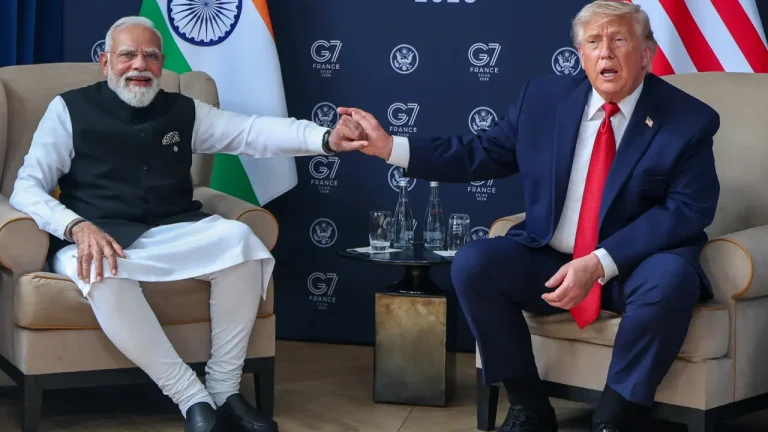
US President Donald Trump praises Indian Prime Minister Narendra Modi at the sidelines of the G7 summit in France, describing him as “the most beautiful man, like an angel” and a leader who loves both India and the US. Yet behind Mr Trump’s praises for Mr Modi lies a more complex geopolitical calculation involving trade negotiations, strategic corridors, defence ties and Washington’s growing leverage over New Delhi.
The meeting, the first between the two leaders in more than 14 months, took place amid disagreements over tariffs, maritime security and the wider balance of power in Asia. While the public optics highlighted personal chemistry, critics argued that several contentious issues remained conspicuously absent from the conversation.
India was expected to use the summit to seek answers from Washington on tariffs, regional security and attacks on Indian seafarers, affecting Indian interests. Instead, Mr Trump’s praises for Mr Modi overshadowed deeper questions about India’s strategic autonomy and its ability to challenge American policies when national interests diverge.
Why Trump praises Modi despite the ceasefire dispute
One of the most politically sensitive issues hanging over the meeting concerns “Operation Sindoor” and the brief India-Pakistan conflict of May 2025.
The conflict followed New Delhi’s strikes on militant camps inside Pakistan after the April 22nd 2025 attack in Pahalgam, Jammu & Kashmir, that killed nearly two dozen Hindu tourists. In the weeks that followed, Mr Trump repeatedly claimed that Washington had helped broker the ceasefire between India and Pakistan.
Pakistan’s Prime Minister Shehbaz Sharif acknowledged an American role in ending the conflict. New Delhi, however, has maintained that the ceasefire emerged from direct military communication between the two countries and not from American mediation.
The disagreement has evolved into a domestic political issue. Opposition parties have demanded that Mr Modi directly challenge Mr Trump’s claims if they are inaccurate. Although the Indian government has denied any American role in the ceasefire process, it has avoided a direct public confrontation with the White House.
The issue goes beyond diplomatic protocol. For many in India, it touches the principle of strategic autonomy, a cornerstone of Indian foreign policy. The perception that Washington played a decisive role in ending the conflict risks fuelling concerns that New Delhi’s security decisions are becoming increasingly vulnerable to external influence.
This is quite harmful for Mr Modi, who has been projected as a strong nationalist leader by his far-right, Hindutva-driven Bharatiya Janata Party (BJP). Enhancing national security has been an important plank of the BJP’s election campaigns at the federal and provincial levels for decades.
After Mr Trump started claiming credit for stopping the India-Pakistan border conflict, the BJP faced a lot of embarrasment as the Opposition attacked the prime minister for allegedly compromising national security.
Trump praises Modi as tariff tensions continue
Despite the warmth displayed during the meeting, trade remains one of the most contentious issues in US-India relations.
During his second term, Mr Trump adopted a more transactional approach towards India than he did during his first presidency. Additional tariffs linked to India’s continued purchases of Russian crude oil increased pressure on New Delhi at a time when discounted Russian energy had become an important component of India’s energy security strategy.
India criticised the tariffs but stopped short of announcing reciprocal measures. Instead, both sides continued discussions on a broader trade agreement aimed at preventing further escalation.
Supporters of closer economic ties argue that improved access to the American market remains essential for India’s export ambitions. The US has been India’s largest trading partner, with which New Delhi enjoys a trade surplus. Critics, however, contend that India’s concessions on sectors such as agriculture, dairy and consumer goods could undermine domestic producers while delivering limited strategic benefits.
The earlier trade arrangement negotiated under tariff pressure was later suspended after legal challenges weakened parts of Mr Trump’s tariff framework. Negotiations nevertheless continued. Commerce Minister Piyush Goyal has indicated that a revised agreement could be finalised within weeks.
Mr Modi’s meeting with Mr Trump also focused heavily on trade. Yet the central question remains whether India can secure favourable terms without sacrificing bargaining power in future negotiations.
Trump praises Modi while maritime tensions remain unresolved
The meeting also took place against the backdrop of rising tensions across West Asia and the Gulf.
Recent American attacks on commercial shipping affected vessels carrying Indian seafarers. One such incident reportedly resulted in the deaths of three Indian crew members, intensifying calls within India for stronger diplomatic intervention.
Mr Modi raised the issue of Indian seafarers during his discussions with Mr Trump. However, New Delhi’s emphasis remained on securing safe passage through critical maritime routes rather than directly confronting Washington over its regional policies.
Acknowledging he knows about the seafarers, Mr Trump downplayed the issue and neither apologised for the killings nor assured any safety for the seafarers in the future. The ambiguity in Mr Trump’s statement on the seafarers, despite his praises for the prime minister, displays Mr Modi’s foreign policy’s weakness.
India’s position reflects a difficult balancing act. The country depends heavily on energy imports that pass through the Strait of Hormuz, one of the world’s most important oil transit routes. At the same time, it seeks deeper strategic cooperation with the US. However, for the US, the relationship is one of convenience.
For New Delhi, instability in West Asia is not merely a security concern. Higher oil prices translate directly into inflationary pressure, increased import costs and broader economic uncertainty. Maritime security therefore remains inseparable from India’s economic interests.
What explains why Trump praises Modi?
Beyond the headlines generated by the meeting lies a broader geopolitical calculation.
The US continues to view India as a central partner in the India-Middle East-Europe Economic Corridor (IMEC), a proposed trade and connectivity network linking South Asia, West Asia and Europe. The corridor forms part of a wider effort to diversify supply chains and create alternatives to China‘s Belt and Road Initiative (BRI).
Although progress has slowed because of conflict in Gaza and wider instability across West Asia, Washington and New Delhi remain committed to the project. Both countries see IMEC as a potential mechanism to reduce supply chain vulnerabilities and expand economic connectivity between Asia and Europe.
The project also carries significant domestic importance for Mr Modi and his BJP. Adani Enterprises, a port-to-power conglomerate owned by Gautam Adani, who is considered close to the prime minister and the BJP, will benefit if the corridor eventually moves from concept to implementation.
Adani Enterprises owns the ports connecting India to West Asia and Israel to Europe. The conglomerate, with deep ties to the US and Israel, also plans to transport hydrogen via pipelines built under the IMEC project.
Mr Modi has been accused of protecting the billionaire, whose rise is directly proportional to the prime minister’s political rise. Adani Enterprises has been accused of several irregularities, including share price manipulation.
During its last days, Joe Biden’s administration had booked Mr Adani and his associates for bribing Indian officials to secure a power supply contract. It was alleged by the Department of Justice that Mr Adani and others had $265m in bribes to Indian officials.
The Opposition accused Mr Modi of liaising with the US president to rescue the billionaire, whose fortunes are tied with his government’s. After Mr Adani hired Robert J Giuffra Jr, one of Mr Trump’s personal attorneys and promised to invest $10bn in the US, the Department of Justice withdrew the case. The Indian Opposition raised doubts over these developments, crying foul play.
Adani Enterprises remain at the centre of India’s bilateral relations with the US, Mr Modi’s critics allege. It’s also alleged that, to ensure Mr Adani’s interests in the US and in the IMEC project are protected, the prime minister has been avoiding direct confrontation with the Trump administration.
The Trump administration, which has been trying to dissolve the anti-China military entente, the Quad, following the president’s trip to Beijing in May 2026, wants to use India as a satellite state to check China’s influence in the Indian Ocean and the Bay of Bengal.
Though the Trump administration relies more on Pakistan as its trusted aide and troubleshooter—as seen during negotiations with Iran—it can’t trust Islamabad when it comes to China because of the duo’s decades-old strong ties. India fills the gap as an alternative power centre that can be used as a pressure point against Beijing.
For Washington, India remains indispensable to this vision. For New Delhi, American political support could prove critical to advancing the project in an increasingly fragmented geopolitical environment.
That convergence of interests helps explain why Mr Trump praises Mr Modi despite continuing disagreements over tariffs, energy imports and regional security.
Trump’s praises for Modi mask a deeper strategic reality
The most important outcome of the summit may not have been the praise itself but what it revealed about the state of the relationship.
Mr Trump’s repeated compliments generated headlines. Yet beneath the rhetoric lies a partnership increasingly shaped by economic interdependence, geopolitical competition and asymmetrical leverage.
The US remains a crucial partner for India in trade, defence, technology and connectivity initiatives. At the same time, New Delhi continues to seek room for independent decision-making in a world defined by intensifying great-power rivalry.
As negotiations on trade, supply chains and regional security continue, the challenge for India will not be maintaining relations with Washington. It will be doing so without narrowing the strategic autonomy that has long defined its foreign policy.
That reality, more than Mr Trump’s praises for Mr Modi, is likely to shape the future of the relationship.
East Post is an independent geopolitical analysis portal covering South Asia and global power dynamics for international audiences. Views expressed are analytical and do not constitute endorsement of any state or non-state actor.
Join our channels on Telegram and WhatsApp to receive geopolitical updates, videos and more.