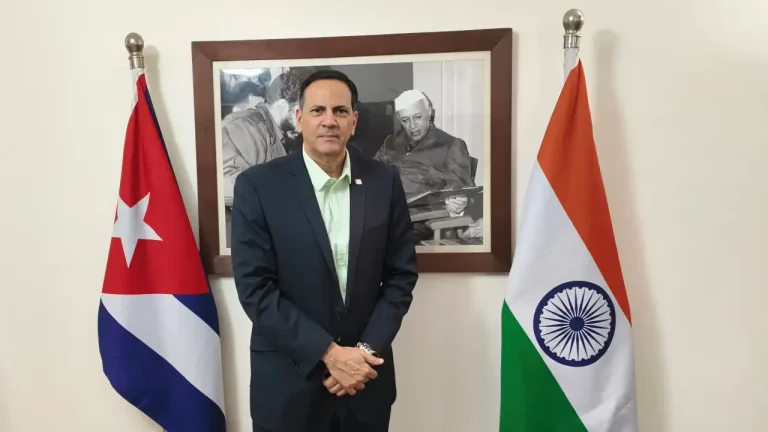
Despite intensifying US sanctions on Cuba and repeated rhetoric from senior American officials, Havana will neither surrender its sovereignty nor abandon dialogue, according to Cuban Ambassador to India Juan Carlos Marsán Aguilera.
Speaking to East Post a day after the UN General Assembly resumed debate on Washington’s decades-old embargo, the ambassador argued that the latest restrictions—particularly those targeting Cuba’s energy supplies—have pushed the island into its gravest economic and humanitarian crisis in years. Yet he insisted that Cuba remains committed to a negotiated settlement based on mutual respect rather than confrontation.
Mr Marsán accused the United States of pursuing an economic strategy designed to destabilise Cuba while warning that any military action would have consequences extending beyond the Caribbean. He also outlined Havana’s economic reforms, its growing partnerships with countries including China, Russia, Vietnam and India, and its vision for preserving Cuba’s socialist system while opening new avenues for foreign investment.
East Post: What do you think regarding the possibility of military aggression now targeting Cuba? The Americans have been deploying their warships and missile destroyers, although they are not saying it right now as much as they were saying in May, because they have suffered in Iran— but the Cuban people are suffering. So, do you think there is a possibility of military aggression now?
Cuban Ambassador: Yes, in fact, there is. There is not because we said that — it’s because in the last month, they have repeatedly mentioned the possibility of military aggression towards Cuba. Several senior leaders in the US have mentioned that, including the US president: “I’m going to take Cuba.” How are you going to take a country? Cuba is a sovereign country. We fought for more than 200 years to achieve our independence, and finally, on January 1st 1959, we gained it under the leadership of Fidel Castro, the historical leader of the Cuban Revolution. We are quite determined to defend our self-determination, our sovereignty. Cuba is not a piece of cake that you can take. US Secretary of State Marco Rubio also said that they are going to use any modality to dominate Cuba, and Secretary of War [Pete Hegseth] even visited the illegal military base in Guantánamo and threatened Cuba, saying they are going to use any means to dominate it. You cannot build a trust relationship with any country by repeating every day or threatening military aggression.
Cuba is a country of peace. For all these years, we have developed international relations based on mutual respect, cooperation, and solidarity. Cuba has cooperated with more than 100 countries, sending medical brigades and contributing to health services for millions of people — not only in Latin America and the Caribbean, but in Africa, Asia, and the Pacific Islands. Cuba always shares what it has to build a new international order based on cooperation and solidarity. We are not seeking confrontation; we are seeking a peaceful solution to any differences between our two countries. We are open to negotiations and to a dialogue based on mutual respect, without any conditions — not imposing on the Cuban people, for example, a regime change or any other policy. It is for the Cuban people to decide which political, economic, and social system we would like to build in our country, and we have done so over the years.
I see three possible scenarios for the US, based on what they are declaring. The first is that they are trying to suffocate the Cuban economy, to put the people in suffering, and to convince the people that the Cuban government is responsible for this situation — not the US. They are looking to mobilise the Cuban people against their own government, to make their own “colour revolution”. They have done this in the past in several countries, and they are looking for the same in Cuba, because Cuba is facing an economic war, not only the threat of military aggression. Cuba faces sanctions daily. For example, on January 29th this year, [US] President [Donald] Trump signed an executive order imposing a blockade on all fuel supplies to Cuba — for the first time, a country was subjected to a blockade on all fuel supplies. They threaten any country that sells oil to Cuba with a 25% tariff. They are also threatening to capture any vessel transporting oil to our country, and they don’t allow Cuba to buy oil from any other country.
Cuba is producing only 20% of the oil we require; the remaining 80% we should import from abroad. This has had a huge impact on the economy. We lack electricity — in recent days, we suffered a full blackout because we cannot produce enough to supply the population. Now we are producing only 40% of the electricity demand; the rest is in blackout, and people suffer every day. It affects water supply, transportation, and the health system. More than 100,000 patients are waiting for medical surgeries, and 15,000 of them are children who need surgery that we cannot provide because of the lack of electricity in our hospitals. We cannot produce sufficient medication — there are more than 300 medications we cannot provide today because our factories cannot work without electricity. We are also suffering in food production because we don’t have sufficient fuel for machinery and irrigation, and productivity has declined. The responsible party for this situation is the United States government.
Cuba was included, just five days after Mr Trump came into the White House, once again on the list of countries that supposedly sponsor terrorism. Ten days before leaving the government, (former) president [Joe] Biden removed Cuba from that list, after more than a year of consultation with different US agencies proving that Cuba does not support any kind of terrorist action against any country, including the US. Why did Mr Trump include Cuba once again? It’s a political motivation — just to create more trouble for Cuba in its efforts to connect with the international banking system. More than 50 international banks have declined to host Cuban accounts because of these sanctions.
The second scenario: after Venezuela, they may think they can do the same in Cuba — a military attack to kidnap the Cuban president. But Cuba is not the same. We have had a revolution for more than 66 years. We have highly consolidated collective political bodies — the party, the government, the state — and strong political mass organisations built on people’s participation in the main political decision-making processes. So it’s not that you take one person, the president, and the country will collapse. It’s not that way.
Of course, we would like to avoid any military aggression against Cuba, because it would have a huge impact on our country — it would devastate our economy and social services. Thousands of people could lose their lives, from Cuba and also from the US, but they could not occupy the country, because we are going to defend every inch of our homeland. We should avoid this. Cuba is a country of peace — in 2014, during the second CELAC summit in Cuba, we adopted a proclamation declaring Latin America and the Caribbean a “zone of peace”. Any military action against Cuba would have an impact not only bilaterally but regionally, in the Caribbean and Latin America, affecting all the supply chains in the region.
We could seek a relationship between the two countries based on mutual benefit and respect. In fact, we did this in the past. I remember that during [Barack] Obama’s presidency, the blockade as a state policy against Cuba remained, but he made many decisions to approach Cuba differently, seeking to build people-to-people connections. We established more than 20 bilateral agreements to cooperate in various fields — combating drug and human trafficking, environmental protection in shared areas, science, joint research on cancer, and education. We didn’t solve everything, but we established new ways of approaching the relationship. In just one year, 2016, a million Americans visited Cuba — Americans who wanted to discover this beautiful island just 90 miles from the US, previously prohibited from travelling there. They found people who are not against Americans, because the Cuban people are very clear about the difference between the American people and the American government. Today, more than 65% of the American population is against the blockade; they would like a more normal relationship between Cuba and the US.
The third scenario is that they expect Cuba to surrender — to say, “We cannot resist anymore, you can own Cuba, you can control the strategic sectors in our country, we will give it to you for free.” They cannot expect that. Of these three scenarios, the only viable option is to establish a formal dialogue—define the agenda and expected outcomes—to conduct formal negotiations and agree on how we can begin solving the main problems between our two countries.
East Post: You said they may be expecting this “Venezuela model.” Given they burned their hands in Iran, do you think they are realistically in a position to engage in another military aggression, especially against Cuba? Or are they using this to hide domestic issues in America — rising costs, etc — especially given that Mr Rubio, who comes from a Cuban background, has a vested interest here? Is it more political rhetoric, or do they really have military aggression on their agenda?
Cuban Ambassador: The Secretary of State of the US, in the case of Cuba, is not following the interests of the US people. He is following the interests of far-right, anti-Cuban groups from Florida. He came from Florida — he’s not Cuban; he has a Cuban background, but he was born in the US, in Florida. In his political career, he has used the Cuban issue as a stepping stone to his own political position and his own money. He is very close to groups that have, in the past, committed terrorist actions against our country, and he is trying to impose his personal agenda in the case of Cuba. The huge majority of the American people are not in favour of a military attempt against Cuba.
Second, there is a strong position of the international community rejecting any military aggression against Cuba. Yesterday, in the UN General Assembly, Cuba requested a special session to discuss the necessity of ending the economic, commercial, and financial blockade of the US government against Cuba. The huge majority of countries supported this request, and we had a full-day discussion. The vast majority took the floor and expressed their opposition to the blockade and to any military aggression — CARICOM, the African Union, ASEAN, China, Russia, and even the European Union voiced opposition to the blockade. Only a few countries — the United States, Israel, Czechia, Poland, Ukraine — supported the US position, but they are isolated against the huge majority. So it’s not so easy for them to justify military aggression against Cuba. Nobody can believe that Cuba — a small island of 10m inhabitants, not attacking or confronting any country — is a threat to the national security of the US. They would be totally isolated in any attempt at military aggression against our country, and we are determined to defend our sovereignty, self-determination, and independence.
East Post: How are the Cuban people coping with this situation right now?
Cuban Ambassador: It’s very, very difficult for the Cuban people. Imagine having more than 20 hours a day without an electricity supply — you cannot preserve food, you cannot cook properly, you can do nothing. It affects transportation, communication, everything. Prices have increased for food and basic necessities. The huge majority of the Cuban population is very clear that the government is not responsible for this situation. Our government is doing everything it can and continues to approve new economic measures to transform the Cuban economic and social model, in order to improve the quality of life for our people. But we are suffering greatly from this US blockade. We cannot wait for the US to change its position towards Cuba to mobilise the population to change the current situation — that is why we adopted these decisions: to strengthen the economy and connect more with the world.
East Post: Are Cubans now receiving support from international allies, including China, Russia, and other Global South countries, in the face of these American sanctions, especially those targeting fuel?
Cuban Ambassador: We have had strong political support from all these countries. The Russian and Chinese governments, in a permanent manner, express their rejection of this US blockade and any attempt at military aggression. Russia and China are also engaging in some business with Cuba. For example, China has cooperated with Cuba on installing almost 1.5 gigawatts of solar panels to supply electricity, working with Chinese companies over the last two years. With Russia, we recently opened a new joint venture in biotechnology to produce innovative vaccines to combat cancer and a new centre in Moscow to manufacture them. We are doing the same with Vietnam — they are participating in Cuban energy production, transportation and e-mobility, providing electric cars for our energy transition, and agriculture, with Vietnamese companies participating in food production, mainly rice.
Politically speaking, we expect the international community, as it demonstrated yesterday, will not accept this economic war against Cuba — because today it is Cuba, tomorrow it could be any other country. The international order cannot be based on unilateral sanctions, oil blockades, or the threat of military aggression against any country. We should respect the principles set out in the UN Charter, which was approved by the international community as a whole. This US government is trying to impose, in Latin America, the Monroe Doctrine — the idea that no other power can have any presence in Latin America against US interests. Latin America doesn’t belong to the US. What we expect from the international community and the Global South is to continue condemning the US blockade, not accepting these economic sanctions or any military aggression, and to continue supporting the Cuban resolution at the UN General Assembly.
East Post: Have you seen any other US administration behave this aggressively in Latin America?
Cuban Ambassador: The US government has always seen Latin America as its “backyard” — this is a thought established across the US political class, in both parties. But this government has gone beyond anything before. For example, the military aggression against Venezuela, kidnapping a legally elected president and putting him in jail in the US — you cannot do that; it disregards all international law. Or killing boats, saying there are traffickers, without any demonstration or evidence, unilaterally, disregarding international law. Or sending military ships to the Caribbean to control who can travel to Venezuela or any other country, kidnapping ships at sea — you cannot do that unilaterally; you should go to the UN Security Council and adopt a common resolution. You cannot control the world just because you want to.
There is also interference in electoral processes. President (Gustavo) Petro of Colombia said, two days ago, that he has proof the US tried to modify the electoral pattern in Colombia to favour the right-wing candidate. They have done the same in other political processes in our region — Bolivia, Chile, Brazil, Mexico.
East Post: So would you say America is going back to the old, direct way of imperialism — rather than the indirect methods it used to use — because they’re getting more desperate, with a domestic crisis at home they want to cover up?
Cuban Ambassador: Yes. If you look at the results of the war in Iran, the situation in the US was even worse — prices for gas, oil, and fuel were rising at the time, and food prices in the market were rising too. They are not gaining from these military operations against countries — they are disrupting logistics chains, specifically oil supply chains. The price of oil has been rising in international markets, causing trouble for many countries dependent on oil imports to support their populations, and for farmers, as fertiliser prices have also increased. They are disrupting the world economy as well.
East Post: You said you are seeking a peaceful resolution to this crisis, not confrontation. What has been the Cuban government’s approach so far to resolving this peacefully?
Cuban Ambassador: We started some dialogue with the US in the recent past. Unfortunately, we haven’t seen much progress. If they are looking for dialogue to pressure the Cuban government, they won’t achieve any results. Any dialogue should be based on mutual respect and non-interference in our internal affairs. They cannot demand political change in Cuba — it belongs only to the Cuban population to decide what kind of government we would like, and who leads it. But we do offer the possibility of cooperation in many fields, as we have done in the past. The Cuban economy is open to foreign investment from all over the world, not limited to a few countries — including the US — in tourism, mining, or other sectors. We are just 90 miles apart; the US could be a leading supplier of food, energy, and many other goods to Cuba. It’s not a problem for us — but without any political conditions.
East Post: The Communist Party’s top-level meeting recently decided on economic reforms. Was this decision taken considering the risk of an American attack, or just to enhance the economy — to avoid a Venezuela-type situation?
Cuban Ambassador: It’s a very authentic process. This is the result of many years of consultation with various experts and mass consultation with the government, universities, and other social and economic actors, because in Cuba, no decision can be taken without consensus. It’s not like other countries — for example, in the US, Mr Trump won the election with the support of only about a third of the population; the rest either didn’t support him or didn’t participate. In Cuba, it’s different: the government represents the whole population, and we need people’s participation to achieve our goals of changing the economic and social model.
These decisions are primarily intended to place greater emphasis on the productive forces in Cuba — for example, by giving a more prominent role to MSMEs (micro, small, and medium enterprises) and the private sector in leading the Cuban economy, facilitating foreign investment, and strengthening connections among different economic sectors. We have opened new sectors to foreign and private investment, including the banking sector — now you can have a 100% foreign-owned company in Cuba, without needing a Cuban counterpart. We are now leasing land for 50 years, which was not allowed before. Companies — foreign, private, or state — can now engage in more direct export and import activities rather than through the state. We have also taken into consideration the current situation of the economy under this economic war from the US, and the need to find new solutions and new partners. But fundamentally, this has been the result of more than five years of consultation and discussion within Cuban society.
East Post: Do you think these measures can help consolidate the Cuban socialist model in the face of American pressure, or could these reforms be viewed as a way to assimilate into the global north/West-based economic order?
Cuban Ambassador: The Cuban president explained very clearly, during the last session of the Cuban parliament, that all these decisions to transform the economic and social model are aimed at sustaining the socialist system in the country — because socialism is based on social justice, and you cannot talk of social justice while suffering in the current situation. We are looking for a transformation of the economic model to find solutions to our problems and to provide a higher quality of life and more social services for the population. For example, we have decided to increase salaries in the state sector, which were very low, to motivate people to work there and retain highly skilled professionals. We are also increasing pensions for older people.
We are also going to focus more on people in need. Today in Cuba, food is distributed to everyone at the same prices, but needs are not equal — so we will focus more on families with three or four children, people with specific diseases requiring more attention, or people with lower incomes, and provide more targeted support, rather than assuring equal assistance to everybody regardless of need.
The state will continue to control the economy and the social model, participating in various sectors — though we are opening some state companies to the private sector while preserving majority state ownership. Strategic sectors will remain under state control — for example, education and healthcare will remain state-run, since we provide free, universal public services in both. So social justice and socialism will remain, but we have to modernise. We are building Cuban socialism — we cannot simply follow what is written in the books from previous centuries or past experiences. We need to find our own model, connected to the world, to the private sector, and to foreign companies.
For example, in the case of India, we are offering Indian companies the opportunity to participate in food production in Cuba — we have 30% of our agricultural land not currently in production, and India, despite its large population, has limited land, so we offer that possibility. We are also offering technology transfer in biotechnology, enabling Indian companies to produce innovative products locally, making them cheaper and more accessible to the Indian population. We are also offering opportunities in mining, sugarcane production, and tourism — we have excellent locations for profitable investment. Energy transition is another sector where India has achieved important results in solar and new energy, and where we could work together.
East Post: What do you expect from South Asian people, not the governments, in the face of this crisis? South Asians have long expressed solidarity with Cuba, rooted in common anti-colonial history. How do you see people in India, Pakistan, Bangladesh, and elsewhere supporting Cuba, and what should that look like?
Cuban Ambassador: There is a strong movement of solidarity with Cuba in India, Bangladesh, Nepal, Sri Lanka, and Pakistan, and they have always been very supportive of the Cuban people — first, in opposing the US blockade, but also contributing directly. For instance, last year, the national Cuba solidarity meeting here in India ran a campaign to collect funds to send medication to Cuba, and they are doing the same right now.
We are also celebrating the birth centenary of Fidel Castro this year, and there are initiatives from these organisations to mark it — but it is also a way to help people understand what is happening in Cuba today. Cuba continues to be a reference point for people around the world — an example that a small island can stand up to a big power. Nobody can accept that a big country has the right to interfere in and control a small one. Fidel was an example of a small island with few natural resources, defending the necessity of building a new international order based on greater justice — cooperation among nations to strengthen economies, health, and education. That is what Cuba can contribute, and continues to contribute, to the world today.
East Post is an independent geopolitical analysis portal covering South Asia and global power dynamics for international audiences. Views expressed are analytical and do not constitute endorsement of any state or non-state actor.
Join our channels on Telegram and WhatsApp to receive geopolitical updates, videos and more.