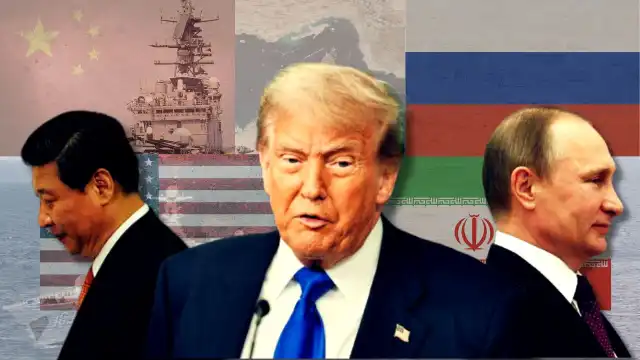
On April 13th, the US moved from pressure to paralysis in its war against Iran, focusing on the Strait of Hormuz. By declaring a naval blockade on Iranian ports—effectively sealing off Tehran’s maritime arteries while asserting control over the Strait of Hormuz—Washington has escalated its confrontation with Iran into a full-spectrum economic and military siege. The move follows the collapse of backchannel talks in Pakistan, closing yet another diplomatic exit ramp.
Yet as the blockade tightens, a different kind of pressure has begun to build—not in Tehran, but across segments of Europe’s left.
The question, repeated with increasing urgency across social media and activist spaces, is deceptively simple:
Why are China and Russia not intervening to stop this war?
The expectation that Beijing or Moscow could—or should—directly confront the US over Iran reflects less a failure of will than a profound misunderstanding of how modern power is structured. This is not the Cold War. China is not the Soviet Union. And the architecture of American military dominance, built over decades, cannot be countered by rhetorical solidarity or even strategic intent alone.
What appears, at first glance, as passivity is in fact the outcome of hard structural limits—military, logistical, economic, and ideological. To demand immediate intervention is to ignore the very asymmetries that have enabled Washington to wage wars like this in the first place.
Empire built for projection
The US does not merely fight wars—it prepares the terrain for them decades in advance.
Across West Asia, Washington has spent years constructing a dense network of bases, logistical corridors, fuel depots, surveillance systems, and integrated air defence architectures. From the Gulf monarchies to occupied zones in Iraq and Syria, this infrastructure forms a lattice of power projection that allows the US to encircle, isolate, and, when required, suffocate adversaries like Iran.
This is not an improvised campaign. It is the culmination of a long-term imperial design.
The scale of this projection is measurable. The US maintains around 750–800 overseas military bases, while China has just one formally acknowledged overseas base (Djibouti) and Russia only a limited number concentrated in its near abroad. The imbalance is not marginal—it is systemic.
By contrast, China’s military doctrine has evolved along an entirely different trajectory. Its force structure is overwhelmingly geared towards territorial defence—securing its periphery, deterring encirclement, and countering the very US military build-up that stretches from the South China Sea to the Western Pacific.
To project decisive force into West Asia would require not just capability, but an entirely different military philosophy—one that China has neither pursued nor institutionalised.
Global Military Balance
A strategic comparison of the top three military powers (2026 Projections)
* A score of 0.0000 is considered “perfect”. Lower scores indicate stronger fighting capability.
🇺🇸 United States
Global Rank: 1 of 145
🇷🇺 Russia
Global Rank: 2 of 145
🇨🇳 China
Global Rank: 3 of 145
Note: Naval Fleet Strength includes all surface and underwater vessels (eg, Aircraft Carriers, Destroyers, Submarines, Patrol Vessels).
Logistics of war — and limits of power
Wars are not won by intent. They are won by infrastructure.
For China to meaningfully intervene in a US-led war against Iran, it would need to replicate—if not surpass—the vast logistical ecosystem Washington has constructed in the region. This includes forward bases, secure supply lines, aerial refuelling networks, long-range strike capabilities, and regional alliances willing to host and sustain such operations.
None of this exists.
Nor can it be conjured amid an ongoing conflict.
Even at the level of raw capability, the gap persists. The US operates 11 nuclear-powered aircraft carriers, compared to China’s three (only two operational for full combat readiness) and Russia’s effectively one ageing carrier with limited deployment capability. Carrier groups are not symbolic assets—they are the backbone of sustained distant warfare.
Even the idea of “over-the-horizon” intervention collapses under scrutiny. Long-range power projection requires not only advanced platforms but also the operational depth to sustain them—something that cannot be achieved without regional basing and logistical integration.
Sending naval assets into the Gulf, for instance, would not shift the balance of power. It would expose them to a battlespace overwhelmingly shaped—and dominated—by the US.
Why China does not build empires
There is a deeper discomfort underlying these expectations—one that reveals a contradiction within parts of the global left itself.
The US built its regional dominance not only through alliances but through coercion, regime capture, and outright invasion. From Saudi Arabia to Bahrain, from Iraq to Syria, its presence is as much political as it is military.
For China to counter this system symmetrically would require adopting the very methods it is often praised for rejecting.
It would mean building its own network of compliant states, forward bases, and military dependencies across West Asia—effectively mirroring the American order.
Beijing has chosen not to.
This choice is reflected in military spending priorities. The US spends roughly $850bn–$900bn annually on defence, while China spends around $290bn. The difference is not just quantitative—it reflects divergent strategic intent. One power seeks global dominance, while another seeks regional security and stability.
This is not merely a moral distinction; it is a strategic one. China’s rise has been anchored in economic integration, not military occupation. To reverse that logic would be to fundamentally alter the nature of its global engagement.
Russia, interests, and end of ideology
The same misreading applies to Russia.
Unlike the Soviet Union, modern Russia does not operate under an ideological mandate to support anti-imperialist struggles across the Global South. Its actions are governed by national interest, not revolutionary doctrine.
This shift has material consequences.
Moscow’s strategic bandwidth is already consumed by the war in Ukraine—a conflict that directly implicates its core security concerns. Opening another front in West Asia would not only stretch its capabilities but also risk undermining its primary theatre of engagement.
Even in comparative terms, the limits are clear. While Russia ranks among the top global militaries, its ability to project sustained force globally is constrained compared to the US, which combines military scale with unmatched logistics, funding, and alliance structures.
This is why Russia has, at times, made decisions that appear contradictory—such as allowing the erosion of allied government in Syria. These are not signs of abandonment, but of prioritisation.
Even at the height of Soviet power, limits were evident. Moscow’s retreat during the Cuban Missile Crisis remains a stark reminder that even superpowers must operate within constraints.
Today’s Russia, with a smaller economic base and a different strategic outlook, is even more bound by such realities.
Time lag of military transformation
There is also a persistent illusion about the transferability of military power. Many expect China and Russia to technologically and militarily upgrade Iran to counter the US-Israeli aggression. That’s not realistic!
Weapons can be supplied. Systems can be exported. But capability cannot be instantaneously transferred.
Integrating advanced military hardware into a functioning force requires years of training, doctrinal adaptation, and operational coordination. This is particularly true for modern combined-arms warfare, where effectiveness depends on the seamless integration of multiple systems across domains.
This gap between hardware and usability is visible across conflicts. Even large-scale transfers of advanced Western systems have not automatically translated into battlefield dominance elsewhere—highlighting that military strength is cumulative, not transactional.
Iran would face similar constraints.
Chinese or Russian support—economic, technical, or even military—can mitigate pressure. But it cannot substitute for the long-term development of indigenous capability.
Dollar, debt, and economics of endless war
Beneath the military asymmetry lies an economic one.
The US occupies a uniquely privileged position within the global financial system. The dominance of the dollar allows Washington to sustain vast military expenditures through debt structures that few others can replicate.
War, in this framework, is not merely a cost—it is part of a broader system of financial and geopolitical reproduction.
This financial edge feeds directly into military dominance. The US accounts for roughly 35–40% of global military spending, enabling it to sustain multiple theatres of conflict simultaneously—something neither China nor Russia can currently match.
China and Russia operate under different constraints.
Both must navigate a global economy still heavily shaped by Western institutions and sanctions regimes. While Russia has partially insulated itself in the wake of the Ukraine war, China remains deeply integrated into global trade networks, with an export-driven model that limits its room for confrontation.
To escalate militarily in West Asia would therefore carry not only strategic risks but systemic economic consequences.
Illusion of immediate resistance
What China and Russia are doing—providing economic support, sustaining Iran’s industrial base, and offering limited military assistance—is not insignificant.
It is, in fact, the outer boundary of what is currently feasible.
To interpret this as passivity is to conflate visibility with substance.
Power does not always manifest in dramatic gestures. Often, it operates through slower, less visible processes—capacity building, economic resilience, and strategic patience.
The demand for China or Russia to “step in” and stop the US is, at its core, a demand for a world that no longer exists.
It is a longing for symmetrical confrontation in an asymmetrical system.
But misreading the limits of power does not strengthen resistance—it distorts it.
And in doing so, it risks turning frustration away from the architecture of American dominance, and towards those who are, for now, still learning how to survive it.
East Post is an independent geopolitical analysis portal covering South Asia and global power dynamics for international audiences. Views expressed are analytical and do not constitute endorsement of any state or non-state actor.
Join our channels on Telegram and WhatsApp to receive geopolitical updates, videos and more.